Psychology Courses After 12th: Courses, Career Options and Jobs in India
If you've spent the last two years of school more interested in why your friends behave the way they do than memorizing formulas, psychology might already be tugging at you. And you're not alone, psychology has quietly become one of the most sorted subjects in India, with students from every stream actively prospecting for psychology courses after 12th.
This isn't a "soft" degree anymore. It's a serious academic path that opens into clinical work, HR, UX research, sports coaching, criminal investigation, corporate wellness and a dozen careers most 12th graders have never even heard of.
Let's walk through what the courses actually look like, who's eligible and what a real career in this field pays and demands.
NOTE: Find education news, career advice, exam updates, study resources, and latest updates.
Why Psychology Has Become Such a Popular Choice
Mental health conversations have moved out of hushed tones and into everyday life at school, at work, even on social media platforms. That shift has created genuine demand for trained professionals like counsellors in schools, therapists in clinics, wellness leads in corporate offices and researchers studying how people think, decide and behave in vast spectrum of situations. So when students search for psychology courses in India, they're not chasing a trend but responding to a job market that's actually growing.
It also helps that psychology sits at a rare intersection. It's scientific enough to satisfy analytical minds yet human enough to reward empathy and curiosity. That combination is exactly why so many students consider it among the better psychology career options in India right out of school.
Eligibility: Who Can Take Up Psychology After 12th?
The good news is that psychology is one of the more accessible degrees to get into. You don't need to have studied it in school and in most cases, you don't even need a specific stream.
- Minimum Qualification: Class 12 pass from a recognized board like CBSE, ICSE or state boards, with 45-50% aggregate marks (this varies by college; top-tier universities may ask for over 60 %).
- Stream Flexibility: Students from Science, Commerce, and Arts/Humanities can all apply for a BA or general BSc in Psychology. Science majored courses which like BSc in Psychology or Neuropsychology requires science background from 10+2 level.
- Entrance Exams: Many state and central universities admit students purely on Class 12 marks like Delhi University has CUET. Others, especially private and deemed universities, may conduct their own entrance test or personal interview to assess aptitude and communication skills.
If you're wondering whether your Commerce or Arts background disqualifies you, it doesn't. Psychology genuinely welcomes students from any academic stream, which is part of why it's considered one of the more approachable psychology courses for beginners wanting to explore the subject without a rigid prerequisite list.
Psychology Degree Courses You Can Choose From
This is where most students get overwhelmed because "study psychology" isn't one path. Here's a breakdown of the main psychology degree courses available right after 12th in India.
1. BA Psychology
BA Psychology degree leans into the humanities side of the subject covering areas like behaviour, perception, social dynamics and decision-making with lighter emphasis on lab-based science. It's a strong fit if you're drawn to counselling, education, human resources or social work and prefer applied, discussion-based learning over heavy statistics.
2. BSc Psychology
BSc Psychology takes a more scientific route, bringing in research methods, biological psychology, statistics and cognitive science. If you enjoyed Biology or found the "why does the brain do that" questions more interesting than the "why do people act that way" ones, this stream suits you better and it sets you up well for clinical or research-focused postgraduate study.
3. BA/BSc Applied Psychology
This variant takes psychological theory and points it directly at real-world problems covering workplace behaviour, forensic investigation, organizational dynamics and community mental health. It's ideal for students who want their degree to feel immediately practical.
4. Diplomas and Certificate Courses
If a full three-year degree feels like too big a commitment right now, shorter diploma courses in areas like child psychology, sports psychology or corporate psychology let you test the waters. They're not a replacement for a full degree if you want a serious career but they're a genuinely useful starting point and among the more affordable psychology courses for beginners often costing a fraction of a full degree programme.
Most undergraduate psychology degrees run three years (or four, under the newer four-year honors structure many universities have adopted) and typically cost anywhere from ₹50,000 to ₹3 lakh a year depending on whether you choose a government or private institution.
How to Become a Psychologist in India: The Actual Path
This is the part students often get confused about, so let's lay it out clearly. A bachelor's degree alone does not make you a licensed psychologist rather it’s the first step in a longer academic journey.
Here's the realistic roadmap if you're figuring out how to become a psychologist in India:
- Complete BA/BSc Psychology (3 or 4 years) after 12th.
- Pursue a Master's degree in Psychology or a specialized area like Clinical, Counselling or Organizational Psychology (2 years).
- For clinical practice specifically, India requires additional licensing through the Rehabilitation Council of India (RCI) which is the statutory body under the Ministry of Social Justice and Empowerment that regulates clinical psychology training and maintains the Central Rehabilitation Register of licensed professionals. Historically this meant an RCI-recognized M.Phil in Clinical Psychology; the Council has been transitioning this pathway toward a 2-year RCI-regulated MA in Clinical Psychology, so it's worth checking the RCI's current guidelines before you commit to a programme.
- Register with the RCI once you complete an approved course, this step is legally required if you intend to independently diagnose, treat or issue mental health certificates as a Clinical Psychologist.
- It's worth noting that this RCI licensing requirement mainly applies to clinical and rehabilitation psychologists. If you're heading toward HR, research, sports psychology, or organizational roles instead, you generally won't need RCI registration but just the relevant degree and, often, some practical experience or certification in your chosen niche.
Psychology Jobs in India: Where the Degree Actually Takes You
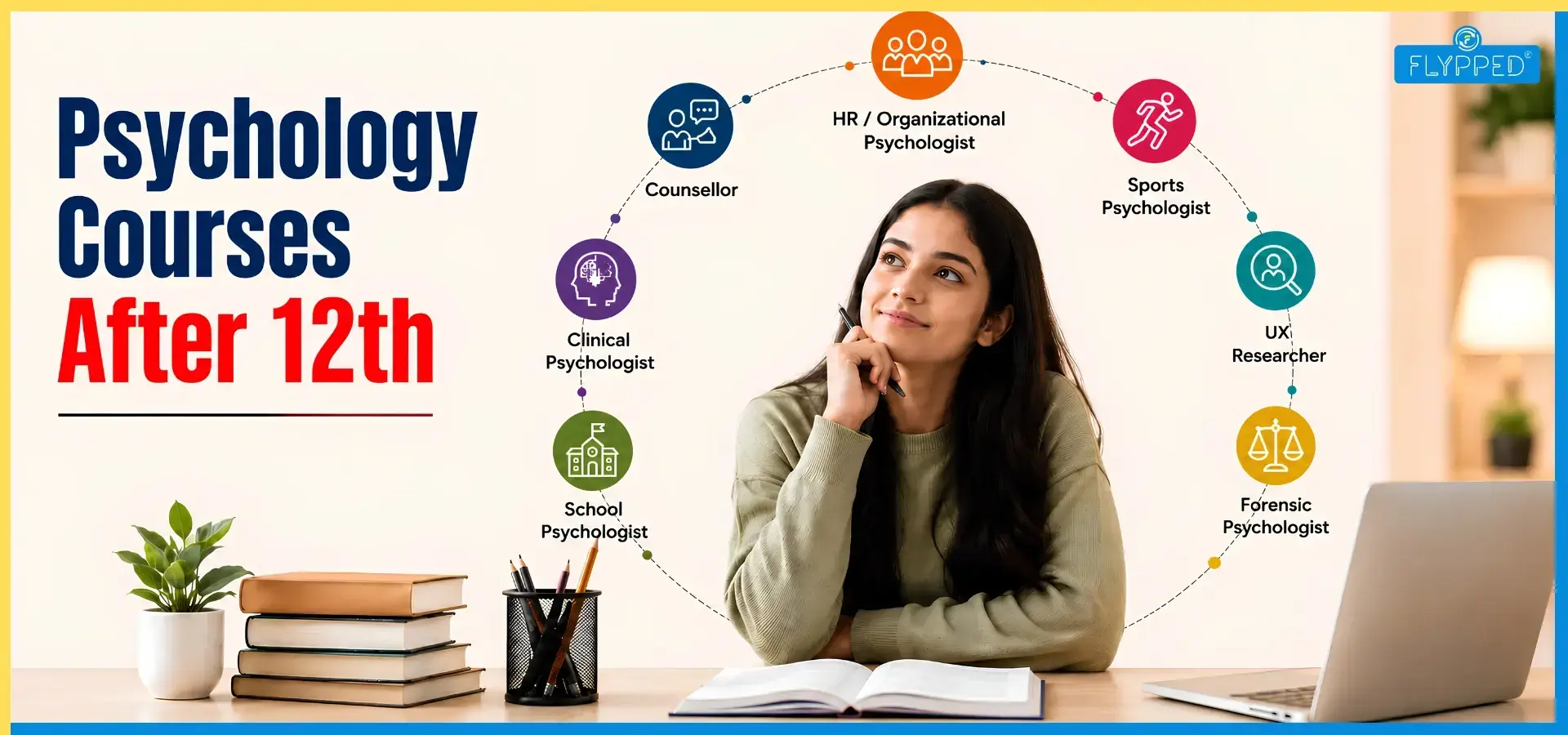
This is usually the question underneath all the others, “ will this degree actually get me a job?”. The answer is yes, provided you're clear-eyed about which specialization leads to which role. Here are some of the realistic psychology jobs in India graduates move into:
| Counsellor | Schools, Colleges, NGOs, and Private Practice |
| Clinical Psychologist | Hospitals and Mental Health Clinics (Requires RCI Licensing) |
| HR/Organizational Psychologist | Employee Wellness, Recruitment and Workplace Behaviour roles in Companies |
| School Psychologist | Supporting Students' emotional and academic development |
| Rehabilitation Specialist | Working with individuals recovering from Trauma, Addiction, or Disability |
| Research Assistant | Academic Institutions, think tanks, and Market Research firms |
| UX Researcher | An increasingly common landing spot for Psychology graduates in tech, since understanding human behaviour is central to product design |
| Sports Psychologist | Working with athletes on performance and mental resilience |
| Forensic Psychologist | Assisting in criminal investigations and legal proceedings |
Salaries vary widely by role and experience. Entry-level positions often start around ₹3–5 LPA, while experienced clinical psychologists, organizational consultants or private practitioners can earn significantly more often ₹10–15 LPA or beyond once they've built a reputation and client base.
Is Studying Psychology a Good Option?
This is the question every parent asks at some point, usually somewhere around admission season. And fairly enough as a degree is a real investment of time and money.
Here's a grounded way to think about the question, “is studying psychology a good option” depends less on the subject itself and more on what you plan to do with it. If you treat a BA or BSc in Psychology as a terminal degree with no further study, your job options will be somewhat limited, mostly entry-level roles in HR, education or NGOs.
But if you're willing to go further, a master's, a specialization, maybe RCI licensing for clinical work; psychology opens into a genuinely wide, resilient career field. Mental health awareness isn't going anywhere, workplaces are investing more in employee wellbeing, and tech companies increasingly want people who understand human behaviour, not just data.
So yes, for a student who's genuinely curious about people and willing to commit to the full academic path, psychology is a solid, future-facing choice not a fallback subject.
Choosing the Right Path for You
There's no single absolute psychology course after 12th as the right one depends on whether you're drawn to science or the humanities, clinical work or applied fields, a long academic runway or a quicker entry into the workforce.
Before you pick a college, it helps to talk to current students, check whether the university offers internships or practical exposure and look honestly at whether you're ready for the years of study that serious specializations especially clinical psychology.
Start with the fundamentals, stay curious about the different branches and let your interests narrow the path as you go. Psychology rewards patience, both in the people who study it and in the careers it eventually leads to.
Read More:
- Career Counselling After 12th
- APAAR ID: What is It, How Is It Relevant For Students
- Pilot Course After 12th: Training, Fees & Career Salary
- How to Prepare for CAT Exam Strategy for High Score
- 10 Time Management Tips for Students: Study Smarter, Not Harder
- Bio Data Format for Job
- Top Courses That Offer Immediate Jobs for Rapid Success
- Online vs Offline Education: Which is Better?
- Study Less, Rank Higher: 7 Science-Backed Hacks to Master Any Subject
Frequently Asked Questions
Find answers to common questions about this topic
There's no single "best" course as it entirely depends on your goal. BA Psychology suits those interested in applied/behavioral aspects; BSc Psychology suits those wanting a research- or science-heavy foundation (useful if you later aim for clinical psychology). BA/BSc Applied Psychology for those who are interested in learning the application of psychology in real-world scenarios. Lastly, certification and diploma courses to test your interest or learn about a particular area.
It varies widely by specialization and experience. Entry-level roles typically pay ₹3-5 LPA. Experienced clinical psychologists, organisational consultants and private practitioners can earn ₹10-15 LPA or more, especially with an established practice or corporate role.
It's not mathematically intensive like engineering, but it does demand strong reading, memorization of theories/research, statistics and long-term commitment if pursuing clinical licensure (bachelor's + master's + RCI registration). Difficulty is more about volume and patience than complex calculations.
Yes, growing steadily. Rising mental health awareness, corporate wellness programs, school counselling requirements and expanding roles in HR, UX research, and healthcare are driving demand. Scope is strongest for those who pursue postgraduate specialization rather than stopping at a bachelor's degree.
Unlikely in the foreseeable future. AI can support tasks like preliminary screening, data analysis or chatbot-based first-line support but core psychological work like building trust, clinical judgment, empathy and personalized therapy relies on human connection that AI can't replicate. It's more likely to be a supporting tool than a replacement.