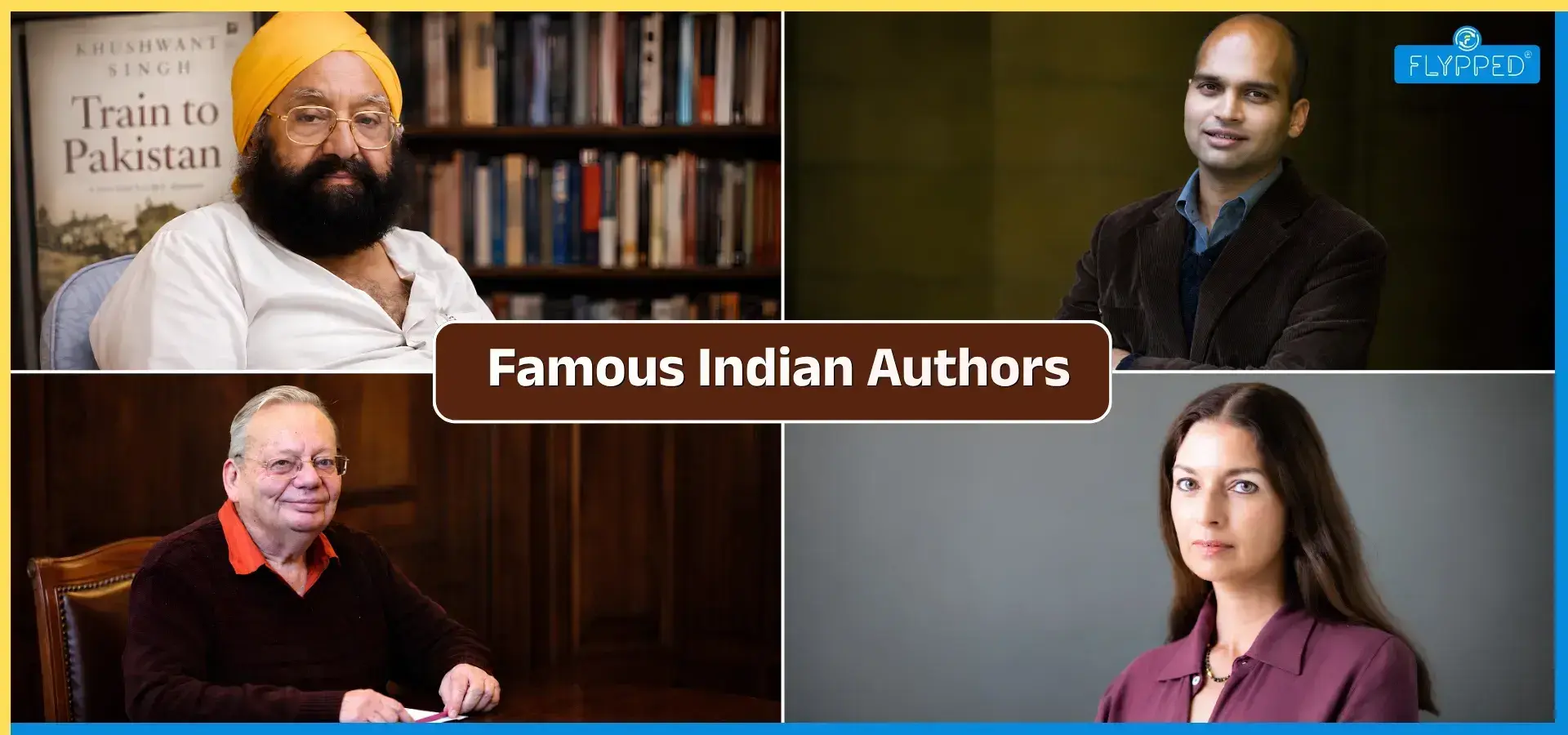
Famous Indian Authors: Top Writers and Their Most Popular Books
Reading books in your free time is a great way to relax. They help us escape the busy world and let us get lost in stories.
Stories let us picture events as they happen in our minds. It feels almost like watching a movie, but through words.
Books can keep us hooked and help us enjoy our own company. In India, many well-known authors have captured readers’ attention with thought-provoking stories and strong plots.
NOTE: Find education news, career advice, exam updates, study resources, and latest updates.
Today, we’re sharing a list of iconic Indian authors and some of their best books.
Famous Indian Authors and Their Notable Books
These ten legendary authors played a key role in bringing Indian literature to global attention. The first one to mention is:
1. Rabindranath Tagore
Rabindranath Tagore was a Bengali poet, short-story writer, composer, playwright, essayist, and painter.
He introduced new prose and verse styles to Bengali literature and favoured everyday language over older classical Sanskrit forms.
Tagore played a key role in sharing Indian culture with the West and introducing Western ideas to India.
Many people see him as the most important creative figure in early 20th-century India. In 1913, he became the first non-European to win the Nobel Prize for Literature.
- Famous Book: Gitanjali (a collection of moving spiritual poems).
2. R.K. Narayan
R.K. Narayan is seen as one of the most important Indian authors writing in English.
His stories often explore the tensions among tradition, modern life, personal freedom, and family ties in India. People know his writing for its friendly humour, gentle irony, and clear style.
Along with other early Indian novelists like Mulk Raj Anand and Raja Rao, Narayan helped make the novel an important part of Indian literature. Anand wrote about social issues, Rao explored complex ideas, and Narayan used simple, humorous language to show everyday life in India.
- Famous Book: Malgudi Days (a wonderful collection of short stories about life in an imaginary town).
3. Arundhati Roy
Arundhati Roy is an Indian writer and political activist. She became known worldwide after her novel The God of Small Things won the Booker Prize in 1997.
Roy often focuses on human rights, the environment, social injustice, and politics in her work.
She has joined protests against the Narmada dam project and has spoken out against the Citizenship Amendment Act (CAA) and its rules.
- Famous Book: The God of Small Things (a story about twin siblings navigating family secrets and social rules in Kerala).
4. Salman Rushdie
Salman Rushdie is an Indian-born British-American writer known for his allegorical novels that explore history and philosophy.
His stories often feature surreal characters, dark humour, and a dramatic style.
Because he addresses sensitive religious and political topics, especially in The Satanic Verses (1988), Rushdie has faced death threats and survived violent attacks.
As a result, he has become an important figure in discussions about free speech and censorship.
- Famous Book: Midnight’s Children (a story about children born at the exact moment India gained independence, who possess special powers).
5. Vikram Seth
Vikram Seth is an Indian poet known for The Golden Gate (1986), a novel in verse, and A Suitable Boy (1993), one of the longest single-volume novels in English.
In 2005, he published Two Lives, a memoir about his Indian-born uncle and German-Jewish aunt and their marriage during major events of the 20th century.
The book was nominated for a National Book Critics Circle Award for autobiography.
- Famous Book: A Suitable Boy (one of the longest single-volume novels in English, focusing on family life and marriage in post-independence India).
6. Khushwant Singh
Khushwant Singh (February 2, 1915 – March 20, 2014, New Delhi) was a well-known Indian writer.
He wrote novels like Train to Pakistan (1956) and I Shall Not Hear the Nightingale (1959), along with many essays, short stories, and a two-volume history of Sikhism.
Singh received the Padma Bhushan, one of India’s highest civilian honours, and served in the Rajya Sabha, the upper house of parliament, from 1980 to 1986.
He also edited respected journals and newspapers such as The Illustrated Weekly of India, the National Herald, and Hindustan Times.
- Famous Book: Train to Pakistan (a powerful historical novel about the human impact of the 1947 Partition).
7. Jhumpa Lahiri
Jhumpa Lahiri was born in London on July 11, 1967. She is an American novelist and short-story writer whose books often explore the immigrant experience, especially for East Indians.
In 2000, she won the Pulitzer Prize for Fiction for her short-story collection Interpreter of Maladies.
Lahiri wrote often during her school years and chose to pursue writing after college.
She graduated from Barnard College in 1989 with a degree in English literature, then earned three master’s degrees and a doctorate from Boston University in the 1990s.
While at Boston University, she studied writing with Elie Wiesel.
- Famous Book: The Namesake (a story about a boy growing up in America while trying to understand his Indian heritage).
8. Anita Desai
Anita Desai is an Indian English-language author known for her novels, short stories, and children’s books.
Her writing often explores emotions, relationships, nature, and cultural differences.
Notable works include In Custody, Fasting, Feasting, The Village by the Sea, and The Artist of Disappearance.
Her short-story collections include Games at Twilight and Other Stories. Her daughter, Kiran Desai, won the Booker Prize for The Inheritance of Loss in 2006.
- Famous Book: Clear Light of Day (a novel set in Delhi about relationships between brothers and sisters growing up).
9. Aravind Adiga
Aravind Adiga is an Indian writer best known for his first novel, The White Tiger, published in 2008.
The book won the Man Booker Prize, and Adiga became one of its youngest winners.
The White Tiger follows Balram Halwai, who leaves his small village and caste to become an entrepreneur in a rapidly growing Indian city.
The story is told through letters to China’s Premier Wen Jiabao and shows that Balram’s path to success involves crime and corruption.
Adiga’s writing criticises modern India, focusing on economic inequality and long-standing injustices, rather than idealised images of the country. His later novels also look at themes from South Asia.
- Famous Book: The White Tiger (a dramatic story about a driver from a small village who tries to break free from poverty).
10. Ruskin Bond
Ruskin Bond is an Indian writer with British heritage. He is well known for books such as The Room on the Roof (1956) and A Flight of Pigeons (1978).
Over the past sixty years, he has published about 500 short stories, articles, essays, and novels.
Many of his stories are set in the hills, especially the Himalayas, and explore themes like nature, childhood, love, loss, and everyday life.
He has also written many children's stories in clear, simple language.
- Famous Book: The Blue Umbrella (a sweet short story about a young girl, a bright blue umbrella, and a greedy shopkeeper).
Famous Indian Female Authors
Women writers from India have brought brilliant perspectives, warm family stories, and strong voices to world literature. Here are five outstanding female authors you should know:
1. Jhumpa Lahiri
Famous for her Pulitzer Prize-winning book Interpreter of Maladies, which tells short stories about love and identity.
2. Anita Desai
Nominated multiple times for top global literary prizes for her deep books like In Custody.
3. Amrita Pritam
One of the most famous Punjabi writers in history, best known for her tragic Partition novel Pinjar.
4. Geetanjali Shree
She made history by winning the International Booker Prize for her groundbreaking Hindi novel Tomb of Sand (translated into English).
5. Arundhati Roy
Famous worldwide for The God of Small Things and her powerful essay collections on society and nature.
Famous Fiction Books by Indian Authors
Fiction books are imaginative stories made up by the author. Indian authors have written world-class fiction across many genres!
Malgudi Days by R.K. Narayan
Perfect for readers of all ages, filled with everyday adventures.
The Guide by R.K. Narayan
A story about a tour guide who accidentally becomes mistaken for a holy man.
Palace of Illusions by Chitra Banerjee Divakaruni
The classic epic Mahabharata retold from Draupadi’s point of view.
The Shadow Lines by Amitav Ghosh
A story about memories, family ties, and international borders.
Life of Pi by Yann Martel
Though Martel is Canadian, the story is set in Pondicherry, India, and remains closely tied to Indian settings!
The Immortals of Meluha by Amish Tripathi
It covers the Shiva trilogy with literary titles - The Immortals of Meluha, The Secret of the Nagas, and The Oath of the Vayuputras. His other works include Ramchandra series, Legend of Suheldev, The Chola Tigers: Avengers of Somnath, and Immortal India, Dharma, and Idols.
Famous Non-Fiction Books by Indian Authors
Non-fiction books are based on real facts, true stories, history, and personal experiences. Indian leaders and thinkers have written some inspiring non-fiction works.
The Discovery of India by Jawaharlal Nehru
Written in prison before India's independence, this book explores India's long culture, history, and traditions.
Wings of Fire by Dr. A.P.J. Abdul Kalam
An inspiring autobiography of India's former President and "Missile Man," sharing how hard work and determination lead to success.
India After Gandhi by Ramachandra Guha
A detailed book explaining the history of modern India after gaining independence in 1947.
An Uncertain Glory by Jean Drèze and Amartya Sen
A book by Nobel laureate Amartya Sen discussing education, health, and development in India.
I Came Upon a Lighthouse by Shantanu Naidu
A warm memoir about working with and learning life lessons from industrialist Ratan Tata.
Famous Indian Children's Book Authors
| Ruskin Bond | Writes heartwarming stories for young readers, including Rusty, the Boy from the Hills and Getting Granny’s Glasses. |
| Roopa Pai | Known for making ancient Indian wisdom simple and fun for children through books like The Gita for Children. |
| Sudha Murty | A celebrated philanthropist and writer, known for charming stories inspired by real life and Indian folklore. |
| Anushka Ravishankar | Known as India’s "Dr Seuss," she writes funny, rhyming verse books like Catch That Crocodile! |
| Paro Anand | Writes realistic, powerful stories for older children and teens, including No Guns at My Son's Funeral. |
10 Famous Indian Authors: Quick Reference
Here is a quick snapshot of ten top Indian authors along with their signature books:
| AUTHOR | NOTABLE BOOK |
| Rabindranath Tagore | Gitanjali |
| R.K. Narayan | Malgudi Days |
| Ruskin Bond | The Blue Umbrella |
| Arundhati Roy | The God of Small Things |
| Sudha Murty | Grandma's Bag of Stories |
| Salman Rushdie | Midnight's Children |
| Vikram Seth | A Suitable Boy |
| Jhumpa Lahiri | The Namesake |
| Khushwant Singh | Train to Pakistan |
| Aravind Adiga | The White Tiger |
Why Indian Authors are Important
Indian authors play an important role in preserving culture and sharing our stories with the rest of the world. Here is why their writing matters so much:
Cultural Connections
They teach us about our own traditions, festivals, languages, and history through fun stories.
Global Understanding
When people in other countries read Indian books, they learn about India's diverse traditions, struggles, and achievements.
Empathy and Compassion
Reading about characters from different places helps us understand people whose lives differ from ours.
Inspiring Young Readers
Simple and engaging stories encourage students to build a daily reading habit, which improves vocabulary, thinking skills, and creativity.
Conclusion
Indian literature is like a giant treasure chest waiting to be opened. From the peaceful mountain tales of Ruskin Bond to the inspiring life stories of Dr A.P.J. Abdul Kalam, these authors have created unforgettable worlds with their words.
Reading books by Indian writers helps us understand our heritage while enjoying incredible adventures. So, the next time you visit a library or a bookstore, pick up one of these amazing titles and start reading!
Read More:
- Career Counselling After 12th
- APAAR ID: What is It, How Is It Relevant For Students
- Pilot Course After 12th: Training, Fees & Career Salary
- How to Prepare for CAT Exam Strategy for High Score
- 10 Time Management Tips for Students: Study Smarter, Not Harder
- Bio Data Format for Job
- Top Courses That Offer Immediate Jobs for Rapid Success
- Online vs Offline Education: Which is Better?
- Study Less, Rank Higher: 7 Science-Backed Hacks to Master Any Subject
Frequently Asked Questions
Find answers to common questions about this topic
Rabindranath Tagore is widely regarded as India's most legendary author, becoming the first non-European to win the Nobel Prize in Literature in 1913 for Gitanjali. Other globally famous authors include R.K. Narayan, Ruskin Bond, and Arundhati Roy, who are celebrated worldwide for their iconic works.
Arundhati Roy won for The God of Small Things, Salman Rushdie for Midnight's Children, and Aravind Adiga for The White Tiger. Additionally, Geetanjali Shree made history by winning the International Booker Prize in 2022 for her Hindi novel Tomb of Sand, translated by Daisy Rockwell.
Ruskin Bond is ideal for his simple, nature-filled short stories, such as The Blue Umbrella. R.K. Narayan offers easy, engaging tales about daily life in fictional Malgudi, while Sudha Murty is beloved for her warm, folk-inspired books like Grandma's Bag of Stories.
Must-read non-fiction titles include Dr A.P.J. Abdul Kalam's inspiring autobiography Wings of Fire and Jawaharlal Nehru's The Discovery of India, which explores Indian history. Ramachandra Guha's India After Gandhi is another essential read covering the nation's post-independence era.
Famous Indian authors are globally significant because they share rich cultural insights, preserve vital history, such as the 1947 Partition, and explore universal themes of identity and migration. Their compelling storytelling bridges Indian heritage and international readers, earning global literary acclaim and inspiring future generations.