
10 Powerful Bhagavad Gita Life Lessons to Transform Your Mind & Daily Life
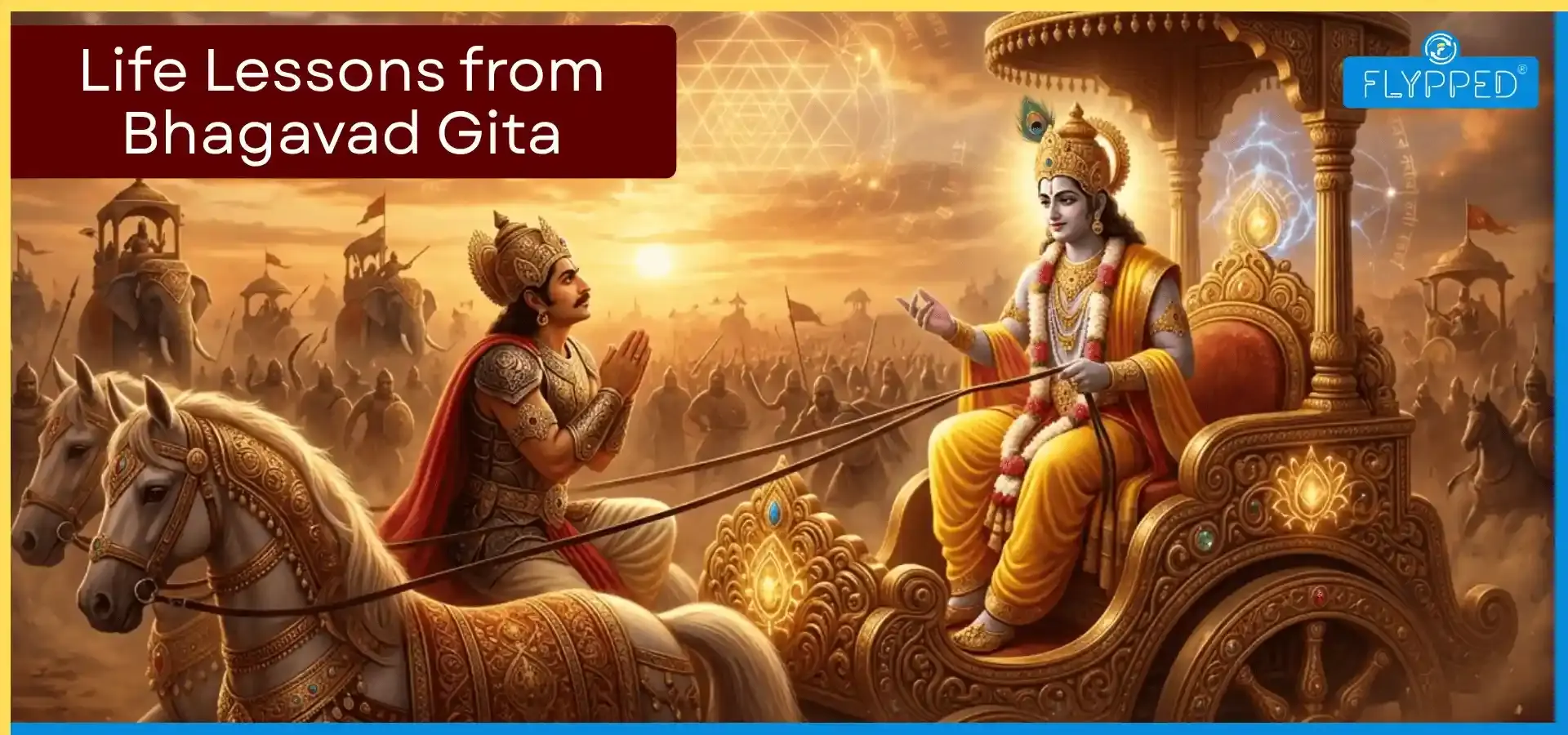
The Bhagavad Gita is one of the most auspicious and revered spiritual texts known in India and the world.
It includes verses spoken during the Mahabharata war, when Lord Krishna stopped time and granted Arjun, the third among the five Pandavas, a wealth of knowledge.
The words spoken in the Gita describe the conversations between these two famous mythological figures.
It all happened when Arjun dropped his weapons in the battle of Kurukshetra. He was finding it difficult to kill his people with whom he had grown up.
Seeing his condition, Lord Krishna became his teacher, encouraging and guiding him in his duty as a warrior.
Well, those pearls spoken from the divine Krishna’s mouth are still relevant as we are all Arjun, who are gripped with some kind of worries and attachments.
Hence, just as Lord Krishna became his charioteer and gave him the right direction, we all must pray to the supreme god to become our charioteer and help us follow the right path.
This is possible only if we read the Bhagavad Gita with devotion, sincerity, and concentration.
The timeless wisdom of the Gita is applicable to people of all ages and backgrounds and will remain a guide for life. Now, let’s know more about it further.
What is Bhagavad Gita?
Bhagavad Gita Written By
Like sage Valmiki, who wrote the Ramayana, sage Ved Vyas is credited with writing the Mahabharata epic with the help of Lord Ganesh.
Where the Mahabharata is all about treachery, war, and other things, the one section which makes it ideal is the Gita Gyaan, meaning ‘song of god’.
It features 700 verses, divided into 18 chapters.
Beyond just a religious text, the Gita is a self-help guide that makes a person find meaning in his life and purpose.
By reading the Gita, a person comes to deeply understand self-control, duty, spiritual growth, detachment, and much more.
People worldwide refer to the Bhagavad Gita for wisdom and inspiration.
Bhagavad Gita Saar (Essence of Gita)
The real essence of the Bhagavad Gita lies in self-realisation and righteousness. It imparts knowledge to people on duty and must not concern itself with results beyond their control.
The sacred text highlights three key paths of life. These are
- Karma Yoga – the path of action
- Bhakti Yoga – the path of devotion
- Jnana Yoga – the path of knowledge
Through these, we learn to become wiser, more responsible, and calmer in challenging life situations.
Importance of Bhagavad Gita in Daily Life
The Bhagavad Gita is not just a book for reading. The gems of knowledge provided in it are filled with practical lessons that, if applied, will help you in dealing with the struggles of your daily life.
In today’s world, where a person is overwhelmed with stress, anxiety, and depression, Gita comes as a guiding force in teaching them how to stay calm in tougher situations and resolve problems wisely.
As we can observe, many people face struggles and pressures in their lives, whether in studies, jobs, relationships, family responsibilities, or societal expectations.
By reading the Gita, we learn about emotional balance and the power of a positive approach. It motivates people to focus more on their actions than on success or failure.
The teachings of the Bhagawat Gita are helpful in making the right decisions in life and relationships.
It lets us instill qualities of confidence, honesty, kindness, and patience. Reading this auspicious text daily results in a more peaceful and meaningful life.
Top 10 Life Lessons from Bhagavad Gita
1. Do Your Duty Without Attachment (Karma Yoga)
One of the important lessons of the Bhagavad Gita is to prioritise your work rather than speculating on its results.
This is what Krishna, the god of love and knowledge, told Arjuna to concentrate on his actions and not to worry about whether he will win or lose the battle.
His lesson is known as Karma Yoga. It defines doing your work with full commitment and not worrying about the outcome.
Hence, Gita is a must-read for students who often lose concentration and fall to distractions.
The sacred book inspires them to prepare well for their exams and not to worry about the marks.
Besides teaching about Karma Yoga, the Gita also teaches the true essence of Dharma, pointing to what is right and being responsible towards one's actions.
2. Control the Mind to Control Life
Among the teachings Lord Krishna gave to Arjuna, one is to control the mind, which keeps wandering.
According to the lord, the mind can be our friend or an enemy. Once you know how to tame it, it results in a positive outcome; if it remains uncontrolled, it can lead you to take the wrong actions that will make you regret later.
Often, the mind becomes restless, leading to stress, confusion, and negativity. The best way to find a solution to this is to cultivate a positive state of mind, self-discipline, and a tamed mind through proper meditation.
The more your mind remains focused and calm, the more it lets you make the right decisions in life.
3. Accept Change as the Law of Nature
People must understand this fact very clearly that nothing is permanent. They must be ready to embrace change in life, be it happiness or sorrow, success or failure.
It is a cycle of nature; nothing remains forever. We are helpless in the course of destiny; hence, we had to accept it calmly. This is what the Bhagavad Gita teaches.
The more a person understands this, the stronger he or she becomes at withstanding difficult situations through patience and strong willpower.
Besides this, it also teaches about detachment, which can become a major cause of worry and often brings major difficulties in one’s life.
Hence, we must not be so emotionally attached to people or to things that give temporary pleasure.
4. Self-Realization is the Ultimate Goal
The Bhagavad Gita also teaches that the human body is not permanent, but the soul residing in it never perishes.
It changes from one body to another as people switch to different clothes. It is a lesson that we must look beyond materialistic pleasures and focus on inner development.
This spiritual concept helps in living life with wisdom and confidence.
5. Practice Detachment, Not Indifference
By detachment, it does not indicate being ignorant of people and becoming devoid of emotions.
Instead, it signifies staying balanced and not getting so attached to people, things, and results.
Through the Gita, Lord Krishna also teaches that a person should care deeply, but must also remain emotionally strong, as this brings mental peace and emotional intelligence.
By knowing balanced living, you will prevent yourself from unwanted stress and distress.
6. Faith and Devotion Lead to Inner Strength
The Bhagavad Gita also reflects on the importance of Bhakti, a practice of surrendering oneself to the almighty god.
In life, there are rough phases that often make you dejected and hopeless.
However, the Bhakti Marg keeps you strong when you trust in that divine power and remain unaffected by unpleasant circumstances.
Faith in God never lets a person fall, but instead makes him stronger and more emotionally stable.
7. Maintain Equanimity in Success and Failure
The Bhagavad Gita also teaches us not to be influenced by either victory or defeat. If you are successful, then it should not go over your head and make you arrogant.
On the other hand, neither failure should leave you feeling hopeless or scared. This is what is known as equanimity, meaning emotional balance.
Learning this equilibrium will always make you stay calm and focused in all situations.
People who have control over their emotions experience success without any fear of challenges. They emerge stronger with it.
8. Knowledge Removes Ignorance
Gita emphasises knowledge as it is the only way a person can lighten their life and remove the darkness of ignorance.
By gaining true knowledge, people come to know themselves better and the world around them.
It keeps fear, ignorance and confusion at bay. Moreover, knowledge shapes students’ character and instills decision-making skills.
9. Discipline and Self-Control Bring Success
The Bhagavad Gita highlights the importance of discipline and good habits. Self-control helps people avoid distractions and harmful desires.
Successful people usually follow routines, manage time wisely, and stay focused on their goals.
Discipline improves personal development and helps people achieve long-term success.
10. Live with Purpose and Righteousness (Dharma)
The Bhagavad Gita teaches people to live with honesty, responsibility, and purpose. Dharma means following the path of truth and doing what is morally right.
Living ethically creates respect, trust, and inner happiness. People should use their talents and abilities to help society and improve the world around them.
A meaningful life is built on kindness, honesty, and responsibility.
Bhagavad Gita for Students
The Bhagavad Gita offers valuable lessons for students. It teaches focus, discipline, and confidence, which are important for academic success.
Many students feel pressure during exams and competitions. The Gita teaches them to stay calm and focus on hard work instead of fear. It also helps students improve concentration and decision-making skills.
The teachings of the Gita encourage students to develop strong character, respect others, and remain honest in their actions. By following these lessons, students can grow into responsible and confident individuals.
Practical Bhagavad Gita Teachings for Modern Life
The Bhagavad Gita is still useful in modern life because its lessons apply to everyday situations.
In workplaces, it teaches leadership, responsibility, and teamwork. It also helps people manage stress and maintain emotional balance.
In relationships, the Gita teaches patience, understanding, and kindness. Its teachings encourage people to communicate honestly and avoid unnecessary anger.
The Bhagavad Gita also supports mental well-being by promoting peace of mind, self-control, and positive thinking.
Key Bhagavad Gita Message for Humanity
The Bhagavad Gita teaches universal values that go beyond religion. Its message is for all humanity.
It encourages peace, compassion, honesty, and selfless service. The Gita reminds people that true happiness comes from inner peace, not only from material success.
By following the teachings of the Bhagavad Gita, people can create a more peaceful and meaningful life for themselves and others.
Conclusion
The Bhagavad Gita is a timeless guide filled with valuable life lessons. It teaches people how to perform their duties honestly, control their minds, stay balanced during success and failure, and live with purpose.
Its wisdom remains relevant even in today’s modern world. Whether someone is a student, working professional, or parent, the teachings of the Gita can help improve decision-making, emotional strength, and inner peace.
The top 10 life lessons from the Bhagavad Gita inspire people to become more disciplined, confident, and compassionate. By applying these teachings in daily life, anyone can grow mentally, emotionally, and spiritually.
Frequently Asked Questions
Find answers to common questions about this topic
Bhagavad Gita contains 700 sacred shlokas divided into 18 spiritual chapters.
The first English translation was done by Charles Wilkins in 1785.
Yes. There is no restriction; spiritual reading is allowed anytime with devotion.
Begin with one chapter daily, read meanings slowly, and reflect on teachings.
Do your duty without attachment and stay balanced in success and failure.
It teaches living righteously and performing oneu2019s duty with honesty.
Compiled by sage Vyasa, part of the Mahabharata epic.