Ajit Doval BRICS Meeting: Cyber Threats and Terror Risks Surge Globally
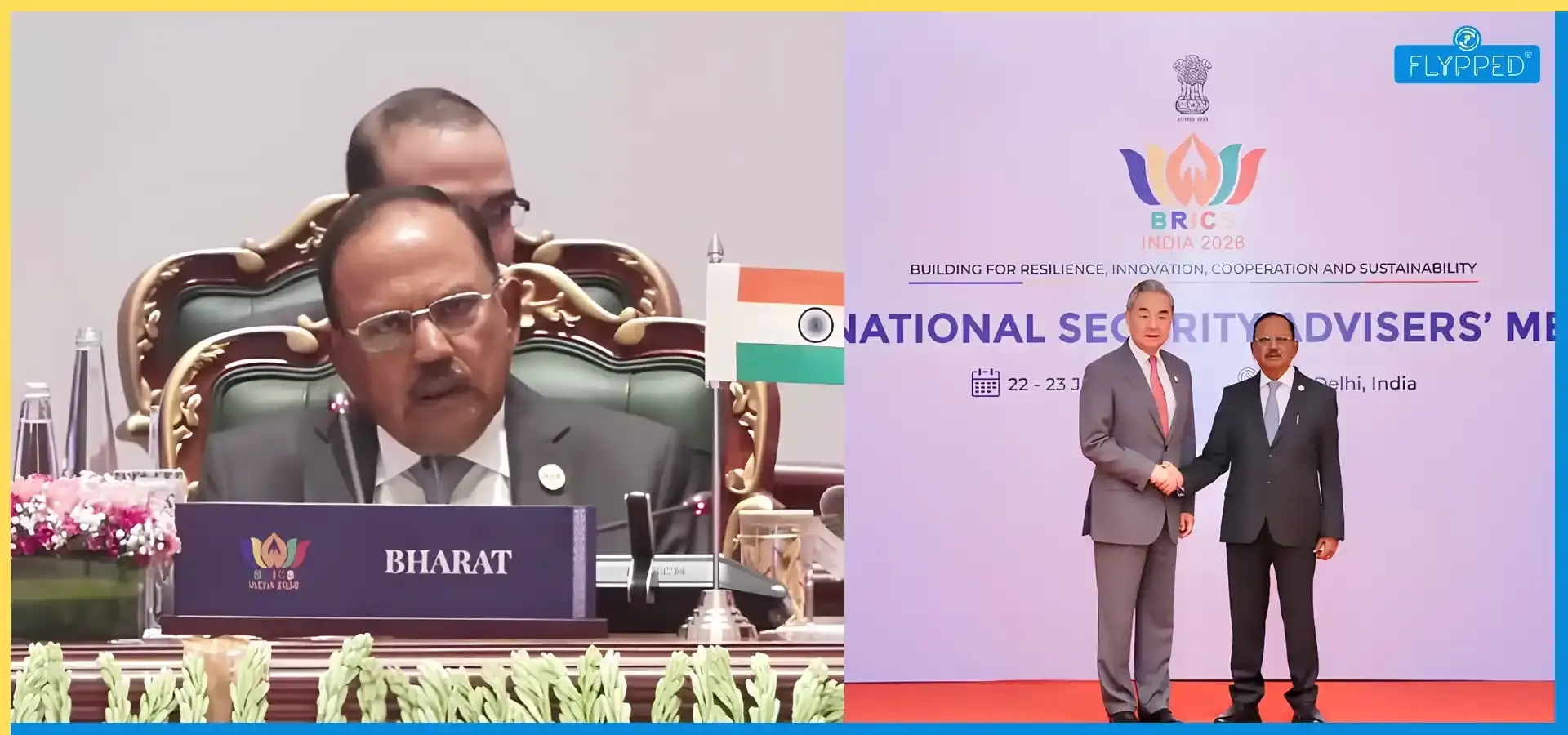
Ajit Doval BRICS Meeting: At the 16th BRICS National Security Advisers’ Meeting in New Delhi, National Security Advisor Ajit Doval spoke openly about global security.
He said that traditional ways of solving conflicts are less effective now because transnational threats are on the rise.
Ajit Doval BRICS Meeting: Doval Urges BRICS Cooperation Amid Weakening Global Security Systems
Doval told security leaders from BRICS countries and their partners that the group has an important role in a world facing instability and complex geopolitical problems.
Doval pointed out that delegates came from many continents and regions, bringing different experiences.
He said global systems for managing conflicts may be getting weaker and urged BRICS members to work together on new challenges.
NOTE: Stay informed with the latest breaking news, current affairs, top headlines, and latest updates from across the globe.
Borderless Threats and Cyber Risks Outpacing Traditional Defences, Warns Doval
Ajit Doval Speech: During the meeting, Doval emphasized that today’s security threats often cross borders and can bypass traditional defence and diplomatic systems.
He said that non-traditional risks are increasing, such as cyberattacks, new types of terrorism, and technology-related security issues.
He said it is important to recognize new security challenges, since transnational and non-traditional threats can now get past traditional defences.
Doval also said that rapid digitalisation has given hostile groups more chances to act, raising the risk to important infrastructure, communication systems, and financial networks.
Ajit Doval on Cyber Threats: Rising Hybrid Threats Demand Shared Global Defenses Ahead of BRICS Summit
Ajit Doval BRICS Meeting: He warned about hybrid threats and said that disruptive technologies and advanced cyber operations are major concerns for national security worldwide.
Terrorism is getting harder to spot and more adaptable, so countries should work together rather than act alone.
He explained that these new threats make traditional defences less effective, so countries need to talk and create shared strategies.
The BRICS NSA meeting is focused on improving cooperation in areas like counter-terrorism, cybersecurity threats, maritime security, and fighting transnational crime before the upcoming BRICS Leaders’ Summit.
Emerging Security Risks: At BRICS Meet, India Pushes for Deeper Security Ties; Doval Holds Talks With Wang Yi
Ajit Doval BRICS Latest News: Officials said India wants members to share more intelligence and work more closely to tackle radicalisation, cyber threats, and risks to important infrastructure.
During the meeting, Doval also met with Chinese Foreign Minister Wang Yi for one-on-one talks as part of broader diplomatic efforts among the countries taking part.
Ajit Doval BRICS Meeting: The New Delhi meeting comes at a time when global security systems are under pressure, and India is presenting BRICS as a practical way to support security cooperation among many countries.
Russian President Putin Confirmed for 18th BRICS Summit in India
Russian President Vladimir Putin is planning to attend the BRICS summit in India later this year. This will be his second visit to India within a year.
The Kremlin has confirmed the news. According to reports, spokesperson Dmitry Peskov said Putin will “definitely” attend the summit.
New Delhi is set to host the 18th BRICS Summit in September 2026. Prime Minister Narendra Modi will serve as the summit\'s president. The event will bring together leaders from major emerging economies amid global uncertainty.
Putin last visited India in December 2025 for a two-day trip. He met with the Prime Minister at the 23rd India-Russia Annual Summit to strengthen bilateral ties.
The visit also marked 25 years since the Declaration on Strategic Partnership was signed, during Putin’s first visit to India in 2000.
BRICS Explained: The Nations, The Impact
BRICS has expanded in recent years and now includes 11 major emerging economies: Brazil, Russia, India, China, South Africa, Egypt, Ethiopia, Iran, Saudi Arabia, the United Arab Emirates, and Indonesia.
The group works together on global political and economic issues like governance reforms, energy security, and development priorities.
Originally formed as BRIC after a meeting of foreign ministers at the United Nations General Assembly in 2006, its first summit took place in Yekaterinburg in 2009. South Africa joined in 2010, turning it into BRICS.
In recent years, the bloc has continued to expand, with new members joining since 2024. Partner countries now include Belarus, Nigeria, Malaysia, and Vietnam.
The United Nations has chaired the United Nations, which follows the theme “Building for Resilience, Innovation, Cooperation and Sustainability.” There is a strong focus on the Global South.
The summit’s main goals include reforming global governance, improving economic resilience and local currency trade, expanding digital public infrastructure, strengthening health security, increasing counter-terror cooperation, advancing climate finance and energy transition, and building closer ties among BRICS nations.
Read More:
- PM Modi Breaks Nehru\'s Record, Completes 4,399 Days as India\'s Elected PM
- Trump Warns Netanyahu Over Iran Strikes, Pushes Diplomacy to Avoid Regional War
- Israel Iran Conflict Escalates as Explosions Rock Tehran After Israeli Strikes
- Sanctions Threats Against India: Putin Praises Modi\'s Leadership and Sovereign Policy
- Trump Praises PM Modi, Signals Breakthrough in US-India Trade Talks
- Malviya Nagar Fire Incident: Gurugram Family\'s Delhi Trip Turns Fatal as Malviya Nagar Blaze Kills 8
- US Tariffs on India: USTR Targets 60 Nations Over Forced Labour Import Rules
- Trump Netanyahu News: Trump-Netanyahu Feud Escalates Amid Lebanon Crisis
- US Iran War Live: Airstrikes, Failed Talks and Rising Middle East Conflict Spark Global Alarm