Skyroot Vikram-1 Launch: PM Modi Wishes Success Ahead of Launch
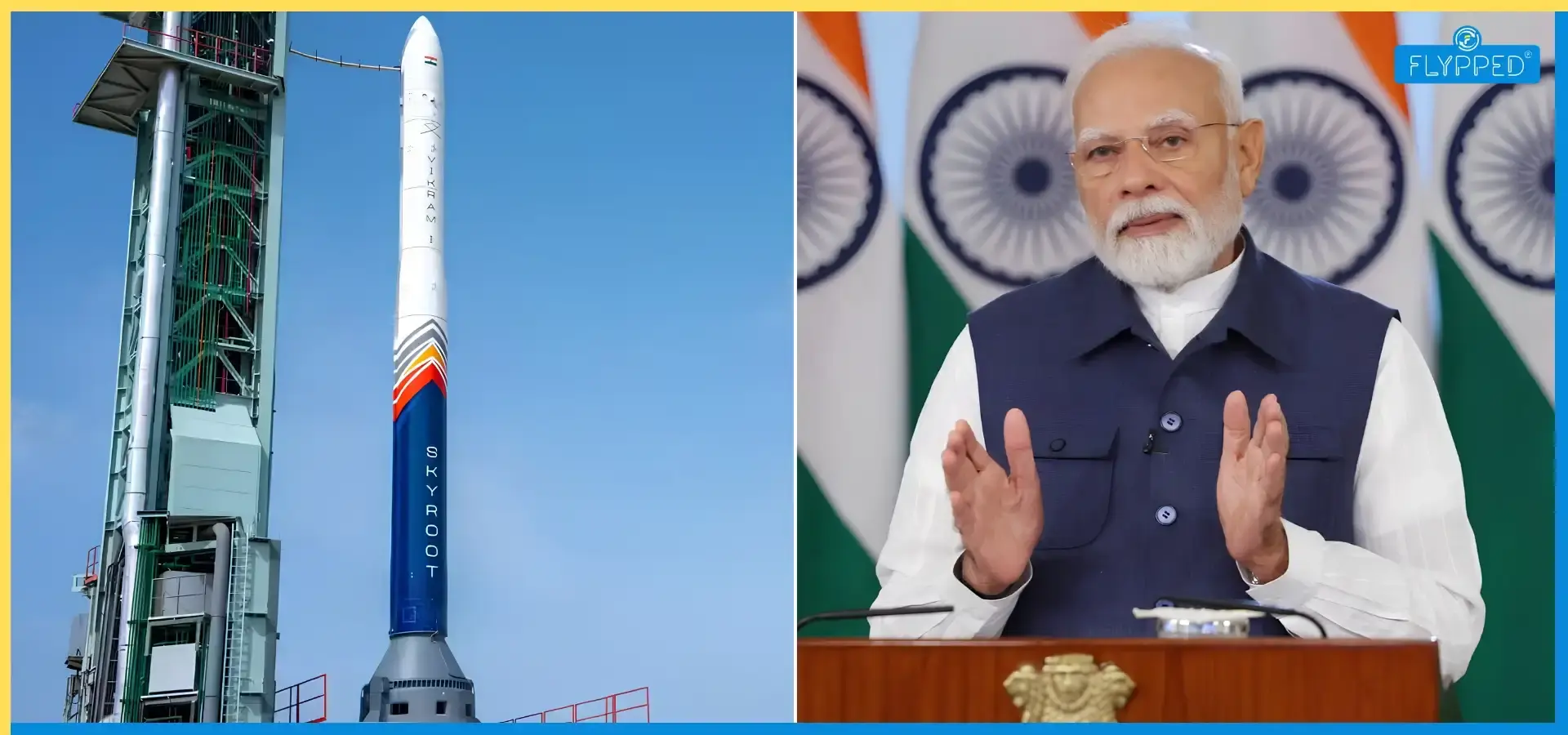
Skyroot Vikram-1 Launch: On Saturday, Prime Minister Narendra Modi wished Skyroot Aerospace success ahead of the first orbital launch of Vikram-1, which is India\'s first privately developed launch vehicle.
He said the mission is an important step in India\'s space exploration journey.
Modi wrote on X that the launch, set for 11:30 am, marks a major milestone for India\'s private space sector.
He said Skyroot Aerospace will carry out the first orbital launch of Vikram-1, India\'s first privately developed launch vehicle.
He added that the four-stage rocket is built for quick, on-demand launches and that the mission highlights the skills of India\'s young innovators.
NOTE: Stay informed with the latest breaking news, current affairs, top headlines, and latest updates from across the globe.
Skyroot Vikram-1 Launch: PM Modi Says Vikram-1 Reflects India\'s Talent and Innovation Spirit
Narendra Modi Latest News: The Prime Minister said the mission demonstrates the talent, determination, and entrepreneurial spirit of India\'s youth.
He also noted that recent space-sector reforms have created new opportunities for innovation and business.
Modi wished the Skyroot Aerospace team success and said he hopes Vikram-1 will make history and inspire the next generation of innovators.
He invited everyone, especially young people, to watch the launch and show their support. The hashtag to be used is #IndiaWithVikram1.
All Eyes on Vikram-1 as It Prepares for Historic Orbital Debut
Vikram-1 First Orbital Launch: The launch, called Mission Aagaman, will see Hyderabad-based Skyroot Aerospace attempt to place satellites into orbit using a launch vehicle designed and built entirely by a private Indian company.
Lift-off is planned at the Satish Dhawan Space Centre in Sriharikota.
According to Skyroot\'s website, Vikram-1 is several metres tall, has a lightweight carbon-composite structure, and uses three solid-fuel stages with a liquid-fuelled orbital adjustment module.
Low Earth Orbit (LEO) Mission: The rocket can carry up to 350 kg to a 450-km Low Earth Orbit (LEO) at a 60-degree angle.
One of its payloads is Diamond Lotus, a lab-grown diamond made by Bengaluru-based Cosmos Diamonds.
India Private Space Mission: Vikram-1 Set to Power India\'s Next Big Leap in Space Technology
Skyroot Vikram-1 Launch: IN-SPACe Technical Director Rajesh Jothi said the mission shows how quickly India\'s private space sector has grown since the government\'s space reforms in 2020.
He explained that the number of space startups rose from just five or six to more than 400 after the reforms.
He added that setting up IN-SPACe in 2022 and putting the Prime Minister\'s vision into action through the new space policy helped the sector grow.
Jothi also said that if Vikram-1 succeeds, it will strengthen India\'s position in the small satellite launch market.
He pointed out that only a few countries have dedicated small-satellite launch vehicles, and success in this mission would help both the small-satellite and small-launch-vehicle markets grow.
Skyroot\'s Vikram-1 Launch Fulfils an Eight-Year Dream
Vikram-1 Launch Latest Update: Founder and Chief Operating Officer Naga Bharath Daka said the company started about eight years ago to develop affordable, reliable, and on-demand launch services from India for satellite operators worldwide.
He said the team\'s years of hard work led to the historic Vikram-1 launch, marking a major milestone for both the company and India\'s private space industry.
Vikram-1 Launch Date and Time: Brief Details
| Detail | Information |
| Mission Name | Mission Aagaman |
| Rocket | Vikram-1 |
| Operator | Skyroot Aerospace |
| Launch Date | 18 July 2026 (Saturday) |
| Launch Time | 11:30 AM IST (official scheduled liftoff) |
| Launch Site | First Launch Pad, Satish Dhawan Space Centre (SDSC-SHAR), Sriharikota, Andhra Pradesh |
| Launch Vehicle Type | India\'s first privately developed orbital-class rocket |
| Mission Objective | Maiden orbital test flight carrying multiple technology demonstration payloads into Low Earth Orbit (LEO) |
| Launch Window | 18 July 2026 |
Skyroot Vikram-1: Unknown Key Facts About India\'s First Private Orbital Rocket
Skyroot Vikram-1 Launch: If the Vikram-1 mission succeeds, Skyroot Aerospace will move closer to providing on-demand satellite launches, often described as a "cab service to space."
Instead of waiting months or years for shared launches on large rockets, customers will be able to book dedicated missions to place satellites into specific orbits.
Named after India\'s space pioneer Vikram Sarabhai, the Vikram-1 rocket can carry payloads of up to 350 kg.
Skyroot CEO and co-founder Pawan Kumar Chandana said the company aims to solve the long wait times faced by satellite operators by offering flexible, customised launch services similar to the model used by US-based Rocket Lab.
The maiden orbital mission will carry six payloads, including an Earth observation camera, a robotic arm designed to remove space debris, and multiple satellites, one of which is built by a German company.
The launch will also feature two symbolic items: a lotus crafted from lab-grown diamonds and a tiny gold rocket carrying microscopic sculptures of Indian scientists C.V. Raman, A.P.J. Abdul Kalam, and Vikram Sarabhai.
Founded in 2018 by former ISRO engineers Pawan Kumar Chandana and Naga Bharath Daka, Skyroot emerged after India opened its space sector to private companies in 2020.
The reforms allowed private firms to build rockets and satellites while using ISRO\'s launch infrastructure.
Today, India has more than 400 space start-ups, with Skyroot standing out as the country\'s first and only private space unicorn.
Skyroot gained national recognition in 2022 after launching India\'s first privately developed suborbital rocket.
As India advances ambitious plans, including a human spaceflight mission, a Venus orbiter by 2028, and a space station by 2035, Skyroot hopes to support future ISRO missions.
However, Chandana expects 70-80% of the company\'s business to come from international clients seeking satellite launches for agriculture, communications, navigation, disaster management, connectivity, and national security.
Read More:
- Ram Temple Donation Controversy: RSS Talks to PM Modi After Donation Theft
- PM Modi Calls Sanae Takaichi Little Sister at India-Japan Annual Summit
- Delhi EV Charging Points: Delhi CM Rekha Gupta Unveils 32,000 EV Charger Plan
- Delhi NCR Rain: IMD Issues Red Alert for Heavy Rain and Thunderstorms
- Netanyahu Warns Iran: Says Iran Could Face Fresh Israeli Strikes if Needed
- Indus Waters Treaty: Pak Minister Musadik Malik Issues Stern Warning to India
- PM Modi Seychelles Visit: Modi Calls for Climate Justice, Receives Top Environmental Award
- Siya Goyal Family Breaks Silence on Ketan Agarwal Murder, Demands Strict Justice
- Mumbai Train Murder Case: Family Demands Death Penalty for Killer After Train Stabbing