Kamakhya Temple History: The Sacred Mystery Behind India’s Most Powerful Shakti Peetha
There’s something majestic about Kamakhya that you can’t quite explain until you have stood at the base of Nilachal Hill and looked up. The air feels distinct there, heavier like the hill itself is breathing. Pilgrims have been climbing this slope in Guwahati, Assam for centuries and the deity they come to meet is unlike any other in the Hindu context. If you’ve ever been curious about Kamakhya temple history, you’re in the right place.
Where It All Begins
To understand Kamakhya, you have to go back to one of the most heartbreaking stories in Hindu mythology, the story of Sati. Sati was the daughter of Daksha, a powerful king and a devoted wife of Lord Shiva. When Daksha organized a grand yajna and deliberately executed Shiva from a guest list. Sati felt humiliated, Sati was humiliated beyond bearing. She immolated herself in the sacrificial fire. When Shiva find out, his grief turned into something terrifying. He lifted Sati’s body on his shoulders and began his cosmic dance of destruction, that is, tandav, threatening to destroy the entire universe in his anguish. To stop him, Lord Vishnu used his sudharshan chakra to dismember Sati’s body as Shiva carried it. Her body fell to earth in 51 pieces. Each spot where a body part landed became a Shakti Peethas (a seat of divine power).
At Kamakhya, it is said that Sati’s womb or genitalia fell on Nilachal Hill. This is why Kamakhya is considered the most powerful of all Shakti Peethas. She is not worshipped in the form of idol here. In the innermost cave of the temple, there is a natural rock cleft, always wet from an underground spring that represents the goddess in her most primal form.
Who Built Kamakhya Temple: The Story Behind Stones
This question doesn’t have a straightforward answer and that’s part of what makes Kamakhya temple history so intriguing.
The worship of a goddess on Nilachal Hill is believed to be ancient predating even recorded Hindu history and likely rooted in the indigenous tribal traditions of Assam’s Khasi and Koch communities the hill itself may have been a place of goddess worship for thousands of years before any formal temple structure existed.
The earliest temple structure is generally attributed to the Koch dynasty particularly King Naranarayan and his brother Chilarai who commissioned a major reconstruction in 1565 CE. But they weren’t the first. There was apparently an older temple that was demolished.
Historical accounts point to Kalapahar, a military commander of Sultan Sulaiman Karrani of Bengal who invaded Assam in 16th century and reportedly destroyed several temples including Kamakhya. The Koch kings rebuilt what was lost.
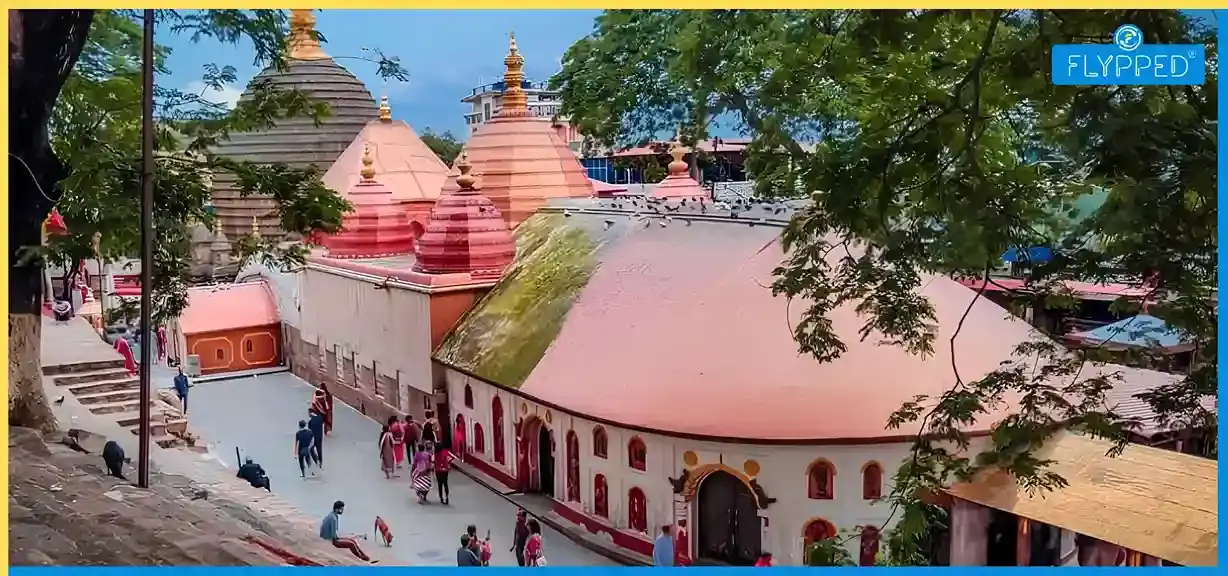
The current temple structure with its distinctive beehive shaped (anda) shikhara looks unlike most north indian and south indian temples reflects a unique Nilachal architectural style. This dome shape is characteristic of temples in this part of Assam and gives Kamakhya its instantly recognizable silhouette.
Over the centuries different rulers added to the complex. The Ahom kings who ruled Assam for nearly 600 years were great patrons of Kamakhya and their contributions, both in construction and elaborate rituals they have established shaped much of what temple looks like today.
Mystery that Draws the World to Kamakhya: Kamakhya Temple & Menstruation
No discussion of Kamakhya temple history is complete without addressing the phenomenon that makes this temple spiritually unique and to many outsiders, deeply mysterious.
Once a year usually in June, the Brahmaputra River near the temple reportedly turns red. The temple closes for three days. When it reopens, devotees line up for hours, sometimes days to receive a piece of white cloth that is said to have been soaked in the menstrual water of the goddess. This cloth is known as angodak prasad which is considered extraordinarily sacred.
Ambubachi Mela is one of the most important and unusual festivals in the Hindu calendar. The belief is that mother earth herself identified with the goddess Kamakhya menstruates during these three days and therefore the temple like a living body rests.
Far from being taboo, Kamakhya temple menstruation is celebrated as a sign of the goddess’s power, fertility and life giving force. This is a temple that doesn’t just acknowledge what other traditions try to hide rather it venerates it. The festival attracts tantric sadhus, yogis and pilgrims across South Asia, all gathered on Nilachal Hill in a scene that is otherworldly.
The Kamakhya temple river connection is equally fascinating. The Brahmaputra which is one of the world’s great rivers flow below Nilachal Hill and the temple geography, spirituality and the river have been intertwined for millennia. Some accounts suggest iron ore deposits near the hill may give the water its reddish tint during Anubabachi.
Inside Kamakhya Temple: What You’ll Actually Find
Many people arrive at Kamakhya expecting a grand and ornate structure but what they find is far more primal and affecting.
The sanctum (garbhagriha) is small, low ceilinged and accessed by steep tone steps descending into a cave. There is no idol rather a sacred object of worship is the rock fissure from the natural springs flows draped in red cloth and fresh flowers. The cave is always cool and damp, the air is thick with incense and devotion. For many visitors this is one of the most genuinely moving spiritual experiences they’ve ever had.
The temple complex also contains shrines to ten Mahavidyas, the ten tantric forms of the goddess including Kali, Tara, Tripura Sundari, Bhuvaneshvari, Bhairavi, Chhinnamasta, Dhumavati, Bagallamukhi, Matangi and Kamala. These subsidiary shrines are arranged around the main temple and visiting all of them is considered deeply auspicious.
The complex also includes a large courtyard, a natmandir (assembly hall) and the pancharatna (five-jeweled) structure that forms part of the main shikhara.
Kamakhya Temple Mystery: Tantra, Sacrifice and the Unexplained
Kamakhya has always been at the heart of the Tantric tradition in India. According to ancient texts, this is where the most powerful rituals were performed. The temple has historically been associated with animal sacrifice which continues in modified form today. On certain festival days, particularly Durga Puja, goats and buffalo are offered as a sacred sacrifice in the outer courtyard. This s not unusual within certain Shakti traditions but it makes Kamakhya a place that unsettles those unaccustomed to it.
Then there is the legend of Naraka, the demon king of Assam (known as Pragjyotishpura in ancient texts) who said to be deeply devoted to Kamakhya. According to the legend, Naraka wanted to marry the goddess Kamakhya which is at the root of one of the most interesting stories about this temple. The goddess, unwilling to accept him, set an impossible condition that he had to build a staircase from the bottom of Nilachal hill to her temple in a single night. Naraka came astonishingly close to completing it but the goddess tricked him by imitating the cry of a rooster at dawn. When he heard it, he believed he had failed and abandoned the task. That unfinished staircase, the Mekhelauja Path is said to still be traceable on the hillside, a reminder of ambition undone.
What is the curse of Kamakhya? This is a question that circulates widely in folklore. One version says that Kamakhya cursed the Brahmaputra river to flow where it does after some ancient mythological transgression. Another says that those who come to the temple with impure intentions leave with misfortune.
What is Kamakhya Temple Famous For?
Kamakhya is famous for being the most powerful Shakti Peetha in Hinduism. It is also famous for Ambubachi Mela, it is an annual menstruation festival. It is also famous as a major centre of tantric practices where sadhu and yogis go for excruciating spiritual practices. It is also famous for being one of the few shrines that touch the taboo subject of menstruation.
Benefits of Visiting Kamakhya Temple
Devotees believe that visiting Kamakhya with genuine faith brings profound blessings. The goddess is said to grant desires related to fertility, marriage, healing and liberation. For those who follow tantric path, she is the ultimate source of Shakti. Even those who are not particularly religious, Kamakhya offers something rare via direct encounter with a form of spirituality.
Kamakhya Temple Timings & Best Time to Visit
The temple is generally open from 8:00AM to 1:00PM and again reopens from 2:30PM to 5:30PM, though timings can vary during festivals and special occasions. The inner sanctum can have very long queues especially on weekends and festive days. Arriving early in morning significantly reduces waiting time.
The best time to visit Kamakhya temple is between October and March, when the weather in Guwahati is cool and pleasant. The monsoon months June-August can be humid and rainy though if you’re hoping to experience Ambubachi Mela, that takes place in June during second or third week.
Both spring and autumn Navratri is also a peak time for pilgrimage when the temple pulses with energy and special rituals take place around the clock.
What Is Not Allowed in Kamakhya Temple
The temple has set of guidelines that all visitors are expected to abide by. Leather items like belts, wallets and shoes must be removed before entering. Photography is not permitted inside the main sanctum. Wearing black clothing is traditionally discouraged. Interestingly, menstruating women are traditionally asked not to enter the inner sanctum, an irony given what the temple celebrates but one rooted in ritual purity customs quite distinct from the theological significance of the goddess’s own cycle.
Final Thoughts
Kamakhya isn’t a temple you simply visit and check of a list. It stays with you. The idea that a goddess has been worship here in her most primal form through blood, earth and water for thousand years say something profound about the kind of spirituality that once existed across this subcontinent. Whether you come as a devotee, traveler or simply someone who is curious about the Kamakhya temple history, it will offer you something real.