Trimbakeshwar Jyotirlinga Temple: Myths, History, Sacred Rituals & Divine Significance
Have you ever noticed that some temples seem to have a stronger presence than others? Trimbakeshwar Jyotirlinga temple in Nashik, Maharashtra, is one of those places where the divine energy feels almost real.
This temple is more than a shrine to Shiva. It is one of the 12 sacred Jyotirlingas in India and stands out because it represents three gods instead of just one.
Let\'s explore what makes this temple unique.
Trimbakeshwar Jyotirlinga Temple: Introduction
Imagine standing at the foot of the Brahmagiri hills, where the Godavari River begins.
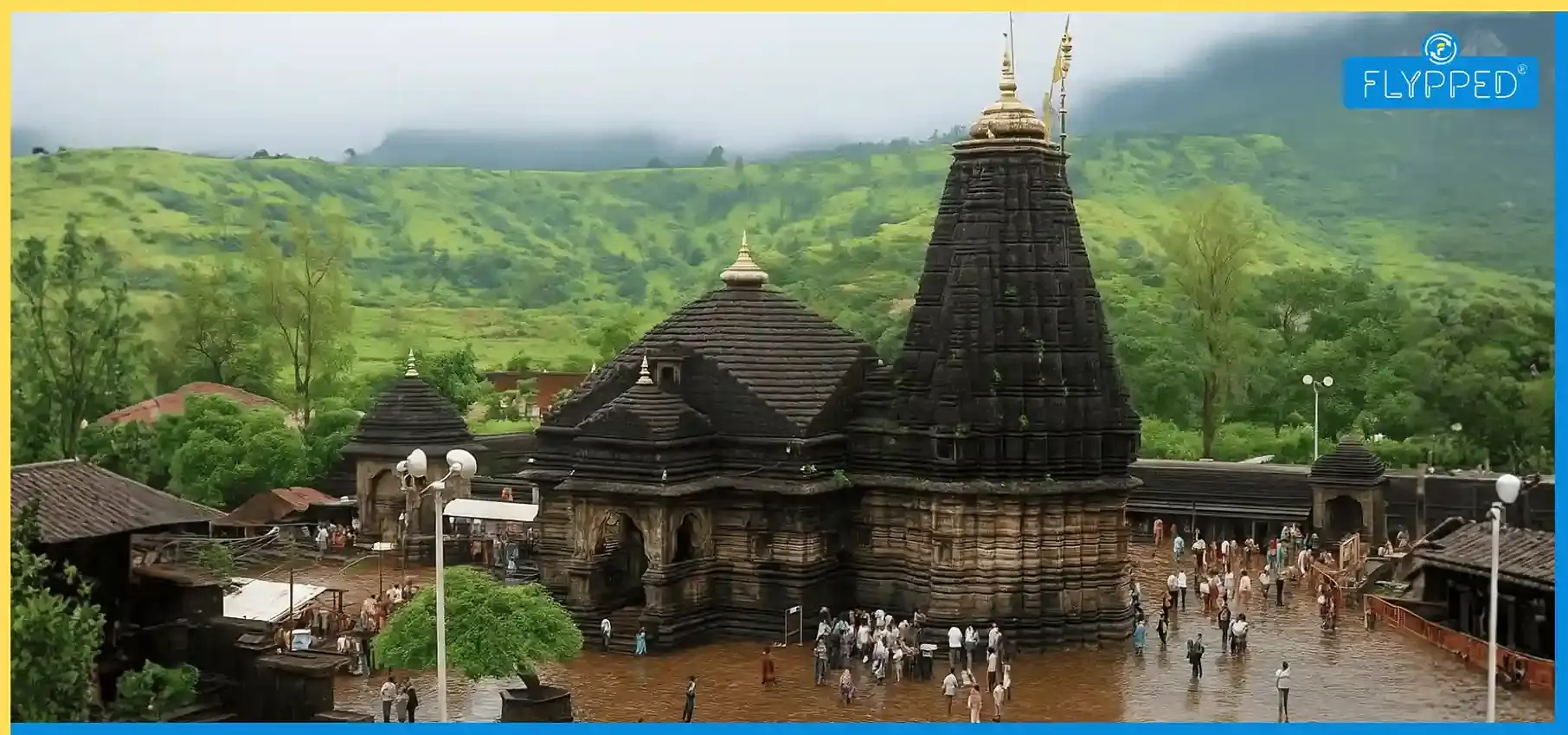
About 28 kilometres from Nashik, you\'ll find the Trimbakeshwar Temple, known for its impressive black basalt walls.
This temple is not just a place to pray; it brings together stories from mythology, moments from history, and a deep sense of spirituality.
What makes this Jyotirlinga unique? While the other eleven are dedicated only to Lord Shiva, Trimbakeshwar honors all three gods of the Hindu Trinity: Brahma the creator, Vishnu the preserver, and Shiva the destroyer.
Here, all three are worshipped together in one sacred Linga. The name "Trimbakeshwar" means "Lord with Three Eyes" or "Three Lords," referring to these divine powers as a group. It’s truly special.
Trimbakeshwar Temple History
Let’s take a look at how this magnificent temple came to be. The building you see now was constructed in the 18th century, between 1755 and 1786 AD, by Peshwa Balaji Baji Rao, also known as Nana Saheb.
There’s an interesting story here: the Peshwa once bet that the stone around the Jyotirlinga was solid.
When he lost the bet because the stone turned out to be hollow, he kept his promise and built this beautiful temple.
But the temple’s story began long before that. Ancient texts such as the Skanda Purana and the Shiva Purana mention this sacred place.
Archaeologists think an earlier temple stood here during the Satavahana dynasty, between the 2nd century BCE and 2nd century CE.
Over the years, the temple went through many changes. It was improved during the Yadava dynasty in the 13th century, destroyed in 1690 during Aurangzeb’s raid, and later rebuilt by the Marathas.
The temple is built entirely of black basalt stone and follows the Nagara style of architecture, also known as the Hemadpanthi style.
This design gives the temple a grand, mysterious appearance, especially when the nearby mountains turn green during the monsoon season.
Trimbakeshwar Jyotirlinga Temple: Mythological Legends
The Story of Lingobhava
Once, Lord Brahma and Lord Vishnu argued over who was right.
To settle it, Lord Shiva appeared as a huge, endless pillar of light, the Jyotirlinga, that stretched through all three worlds.
Shiva then challenged both gods to find the ends of this pillar.
Brahma turned into a swan and flew upward, while Vishnu became a boar and went downward.
Neither of them could find the end. Brahma claimed he saw the top, but he was lying. Shiva was so angry that he cursed Brahma, saying he would not be worshipped on earth.
In response, Brahma cursed Shiva to be pushed underground. This is why the Jyotirlinga at Trimbakeshwar is set in a hollow below ground level, making it unique among all Jyotirlingas.
Story of Gautam Rishi
Here\'s another interesting story. Long ago, sage Gautama and his wife Ahilya lived in an ashram on the Brahmagiri hills.
For twelve years, the area suffered from a terrible drought, and people struggled to find enough food and water.
But thanks to Gautama’s devotion, his ashram always had plenty. The gods had blessed him with a magical pit that never ran out of grains.
Some other sages grew jealous of Gautama’s good fortune. They tried to trick him by sending a cow into his fields.
When Gautama tried to chase the cow away with grass, the cow died by accident. Killing a cow, known as go-hatya, was seen as a serious sin.
Gautama felt heartbroken and deeply upset. To make up for his mistake, Gautama did strict penance for thousands of years on Brahmagiri Hill.
He prayed to Lord Shiva, asking for the sacred Ganga to come and purify his ashram.
Lord Shiva was touched by Gautama’s devotion and agreed to help. Shiva let the Ganga flow from his hair, but the river could not move freely because of his power.
Instead, it appeared as a stream through the Trimbak hills, which became the holy Godavari River.
But the story does not end there. Ganga agreed to come down only if Lord Shiva would stay there too.
So Lord Shiva appeared as the Trimbakeshwar Jyotirlinga, making the place sacred forever.
Trimbakeshwar Significance
Every year, millions of devotees come to Trimbakeshwar because of its strong spiritual significance. Here are a few things that make this temple special:
- The Trinity in One: Trimbakeshwar is the only Jyotirlinga where all three aspects of the divine are worshipped together: creation (Brahma), preservation (Vishnu), and destruction (Shiva). The Linga has three small faces, each showing one of these gods.
- Origin of Godavari: The Kushavarta Kund is a sacred pond inside the temple and is the source of the Godavari River, which is India’s second-longest river. Many people believe that bathing here cleanses sins and brings spiritual purity.
- Moksha (Salvation): In Hindu belief, visiting Trimbakeshwar and bathing in the Godavari can help someone achieve moksha, which means freedom from the cycle of birth and death.
Rituals
The temple is also known for special rituals that are not often performed elsewhere:
Kaal Sarp Dosha Puja
This ritual is performed to remove negative effects when all the planets in a person’s birth chart are positioned between Rahu and Ketu.
Narayan Nagbali Puja
This ceremony is meant to remove ancestral curses and bring peace to those who have passed away.
Tripindi Shradh
This ritual is done for ancestors who did not receive proper last rites.
Mahamrityunjaya Jaap: This chant is believed to help with good health and a long life.
Kumbh Mela
Every 12 years, Trimbakeshwar hosts the huge Kumbh Mela, which is one of the world’s largest religious gatherings.
The Shaivite tradition still sees Trimbakeshwar as the true place for this festival.
People from all over India come to the temple for these rituals, as they are thought to work best when done at Trimbakeshwar.
More Facts About Trimbakeshwar Temple Information
When you arrive at Trimbakeshwar Jyotirlinga Temple, its dark and majestic beauty stands out right away.
The temple is made from black basalt stone, giving it a powerful, ancient feel. Its design follows the Nagara style, a North Indian tradition known for tall, mountain-like spires called Shikharas.
Here’s what makes the temple’s architecture special:
The Main Entrance (Mahadwar)
- The temple features a grand entrance gate, along with four more entrances facing East, West, North, and South.
- This shows that the divine is open to everyone.
- Once inside, you step into a large courtyard surrounded by smaller shrines dedicated to various deities.
- Many small Shiva Lingas are placed in shrines near the temple’s walls.
The Shikhara (Spire)
- The graceful tower rises high, topped with a giant Amalaka (disk-like stone structure) and a golden Kalasha (pot).
- This spire represents the cosmic mountain Mount Meru, connecting earth to heaven.
The Sanctum (Garbhagriha)
- This is the center of the temple. The inside is square, while the outside is shaped like a star.
- The sacred Jyotirlinga sits in a hollow below ground level, which is unique among all Jyotirlingas.
- The three-faced Linga is always bathed in water, slowly wearing it down. Some believe this erosion shows how human life is always changing.
The Jewelled Crown
- The Linga is covered with a beautiful crown made of jewels, placed on a gold mask that shows the three gods.
- People believe this crown is from the time of the Pandavas in the Mahabharata. It is decorated with diamonds, emeralds, and other precious stones.
- Every Monday from 4 to 5 PM, devotees can see the crown on display.
- The temple once had the famous Nassak Diamond on Shiva’s forehead, but the British took it during the Third Anglo-Maratha War in 1818.
Mandapa (Hall)
- In front of the sanctum, there is a hall with doors on all four sides.
- Three of these doorways have decorated porches with beautifully carved pillars and arches.
- The walls and pillars are covered with detailed carvings of Hindu gods, flowers, people, and animals, each with its own story.
Special Mirror
- A special mirror is placed high up so devotees can see the deity’s reflection from outside.
- Only male devotees who are performing certain rituals are allowed inside the inner sanctum.
- The temple’s carvings and pillars are like lessons in devotion and the divine, showing how culture is expressed in stone.
Trimbakeshwar Shivling
Trimbakeshwar is an old Hindu pilgrimage town located where the Godavari River begins, which is the longest river in peninsular India.
The town is known for having one of the twelve Jyotirlingas. This Jyotirlinga is special because the Linga in the temple has three faces, symbolizing the Tridev: Lord Brahma, Lord Vishnu, and Lord Shiva.
Who Built Trimbakeshwar Temple?
The Trimbakeshwar Jyotirlinga Temple, rebuilt by Balaji Bajirao between 1740 and 1760, stands on an ancient sacred site, reflecting deep historical and spiritual importance.
Each of the temple\'s four gates—North, South, East, and West—underscores the temple\'s inclusive spiritual focus.
The temple\'s design ensures every direction represents unique spiritual significance.
East signifies new beginnings, West marks maturity, North stands for revelation, and South represents fulfilment, each reinforcing the temple\'s spiritual depth.
In 1954, the Sansthan\'s registration as a public trust reinforced its community-oriented mission.
Shri Trimbakeshwar Sansthan upholds tradition through daily worship and major festival celebrations throughout the year.
Trimbakeshwar Temple Timings
Trimbakeshwar Jyotirlinga Temple is open from 5:30 AM - 9:00 PM. Its complex is very spacious and has a good queue system.
One can also have a special darshan by paying an additional amount.
Before entering, please make sure you don\'t carry your mobile or camera inside, as photography on the temple premises is strictly prohibited.
Also, you have to keep your bags at nearby shops, where attendants will hold them securely during your visit.
The rest of the temple complex maintains wide-open spaces, which help ensure crowd safety.
Godavari River, Trimbakeshwar
Trimbakeshwar Jyotirlinga Temple is not just famous as a sacred site, but also as the source of the sacred Godavari River. For this reason, it is often called the Godavari River Jyotirlinga.
The river, also known as ‘Gautami Ganga,’ is considered the most sacred in peninsular India.
It begins in the Brahmagiri mountains, just behind the well-known Trimbakeshwar temple.
According to legend, sage Gautam worshipped Lord Shiva and asked the Ganga to come to Earth to help him wash away his sins.
Shiva, pleased with devotion, agreed, and the Ganga appeared as the Godavari River. Since then, people have believed that this sacred river purifies both the land and its people.
Frequently Asked Questions
Find answers to common questions about this topic
Trimbakeshwar Jyotirlinga Temple is one of the twelve sacred Jyotirlingas dedicated to Lord Shiva. It is highly revered because the origin of the Godavari River is located nearby. The temple symbolizes divine power, spiritual purification, and attracts devotees seeking blessings, peace, and liberation from past karmas.
The temple is situated in Trimbak, near Nashik in Maharashtra, India. Nestled at the foothills of the Brahmagiri Hills, it is surrounded by scenic landscapes and religious sites. The location is considered sacred as it is closely associated with Hindu mythology and the source of the Godavari River.
The temple generally opens early in the morning and remains accessible until late evening, with breaks for rituals and ceremonies. Timings may vary during festivals and special occasions. Visitors are advised to check the latest schedule before planning their trip to ensure a smooth darshan experience.
The temple is famous for rituals such as Narayan Nagbali, Kalsarpa Shanti, Tripindi Shraddha, and Rudrabhishek. These ceremonies are performed to address ancestral issues, remove obstacles, and seek spiritual growth. Devotees from across India visit the temple specifically to participate in these sacred Vedic rituals.
The ideal time to visit is between October and March when the weather is pleasant. The monsoon season also enhances the beauty of the surrounding hills. Major festivals like Mahashivratri and Shravan month attract large crowds, offering a vibrant spiritual atmosphere for devotees.