
Richest and Poorest States in India: 2026 State Rankings
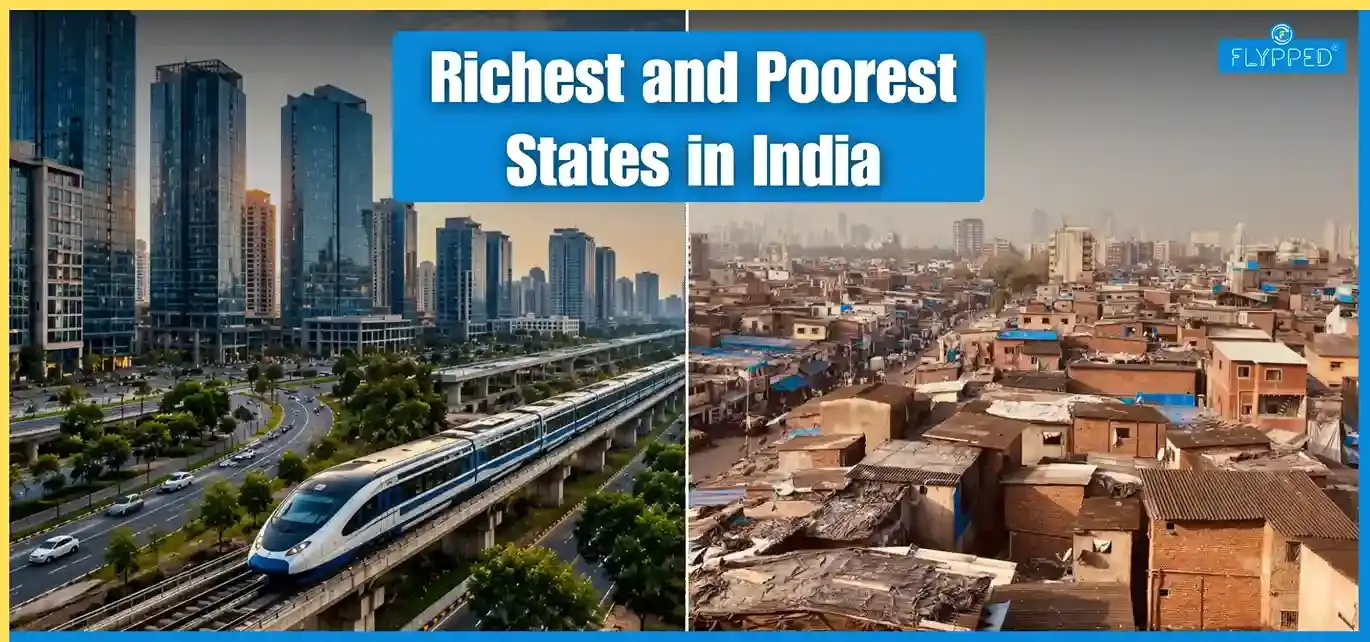
India's economy continues to grow rapidly, but prosperity within the country remains far from evenly distributed. Some states generate enormous wealth and offer their residents a high standard of living, while others continue to struggle with poverty, limited industrialization and weak infrastructure.
Understanding the richest and poorest states in India in 2026 gives us a clearer picture of how uneven development really is, and why bridging this gap remains one of the country's biggest economic priorities. In this blog, we break down the latest rankings using updated RBI and NITI Aayog data, the factors driving this divide and what the 2026 landscape looks like compared to previous years.
How Do We Measure "Rich" and "Poor" States?
Before diving into the rankings, it helps to understand the two most common yardsticks used to measure a state's wealth:
- Gross State Domestic Product (GSDP): The total value of all goods and services produced within a state in a given year. It reflects the overall size of a state's economy.
- Per Capita Income (Net State Domestic Product per person): This divides the state's income by its population, giving a more accurate sense of individual prosperity. A state can have a huge GSDP but still post low per capita income if its population is very large.
This distinction matters a great deal when discussing the richest state in India because the answer changes depending on which metric is used and the latest RBI Handbook of Statistics on Indian States makes that contrast sharper than ever in 2026.
NOTE: Explore travel guides, destination ideas, travel tips, and latest updates for your next journey.
Richest State in India: Maharashtra Leads by Size, Delhi Leads by Income
According to the most recent data, Maharashtra remains the India richest state by total economic output, with a GSDP of around ₹45.3 lakh crore, the largest of any state in the country. Tamil Nadu follows at roughly ₹31.1 lakh crore while Uttar Pradesh has climbed to about ₹29.7 lakh crore, narrowly surpassing Karnataka's ₹28.8 lakh crore in absolute terms.
However, when it comes to per capita income, a very different hierarchy emerges. Delhi now tops the per-capita NSDP rankings at approximately ₹4.93 lakh per person, reflecting its status as a major hub of government, business and urban commercial activity. Goa also continues to rank among the most richest state in india by individual income, helped by its tourism-driven economy and small population base.
Interestingly, the 2026 data shows that mid-sized states like Haryana, Himachal Pradesh and Uttarakhand are now outperforming several larger industrial states in per-capita terms, proving that smaller economic size doesn't necessarily mean lower individual prosperity.
Top 5 Richest State in India: 2026 Update
Based on the latest GSDP figures and per capita performance, here's the updated top 5 richest state in India:
- Maharashtra: Still the largest economy by GSDP at ₹45.3 lakh crore, anchored by Mumbai's finance sector along with strong manufacturing and pharmaceutical industries.
- Tamil Nadu: The second-largest state economy at ₹31.1 lakh crore, driven by its automotive industry, textile manufacturing and growing IT services sector around Chennai.
- Uttar Pradesh: Ahead of Karnataka in total GSDP at ₹29.7 lakh crore, though its per capita income remains comparatively low at around ₹1.08 lakh due to its massive population.
- Karnataka: At ₹28.8 lakh crore GSDP, Karnataka continues to be a technology powerhouse anchored by Bengaluru's software and innovation ecosystem.
- West Bengal: With a GSDP of around ₹18.2 lakh crore, West Bengal rounds out the top tier through its diversified industrial base and strategic eastern trade location.
Among smaller economies, Telangana (₹16.4 lakh crore) and Andhra Pradesh (₹15.9 lakh crore) continue to post strong numbers while Delhi and Goa remain the states to watch for individual income rather than total output.
Why Some States Are Richer Than Others
A few consistent patterns explain why certain states continue to pull ahead economically in 2026:
- Industrial Diversification: States like Maharashtra and Tamil Nadu have multiple thriving sectors instead of relying on just one industry, cushioning them against sector-specific slowdowns.
- Urban Hubs: Cities like Mumbai, Bengaluru and Chennai continue to attract investment, skilled labour and infrastructure spending, lifting the surrounding state economy.
- Smaller Population Base: Delhi, Goa, Himachal Pradesh and Uttarakhand post strong per capita figures partly because their output is divided among far fewer people compared to states like Uttar Pradesh or Bihar.
- Urbanization and Commercial Density: Delhi's rise to the top of the per-capita rankings highlights how concentrated commercial and government activity can outperform even large industrial economies.
- Strong Policy Environment: States that maintain investor-friendly regulations and consistent infrastructure spending continue to see compounding economic benefits year over year.
The Other Side: Poorest States in India in 2026
While the richest states dominate headlines, it's equally important to look at the list of poor state in India for a complete picture. According to NITI Aayog's Multidimensional Poverty Index (MPI) and the latest RBI income data, Bihar, Jharkhand, Meghalaya and Madhya Pradesh remain among the states facing the deepest economic challenges in 2026.
Bihar: Still the Most Poor State in India
Bihar continues to be ranked as the very poor state in India, both by poverty headcount and per capita income. As of the latest 2025-26 estimates, Bihar's per capita income stands at roughly ₹1.3-1.4 lakh, still the lowest among all Indian states, equal to only about 39% of the national average. Around 33.76% of Bihar's population continues to live below the poverty line, despite the state accounting for nearly 9-10% of India's total population.
That said, recent NITI Aayog data does show gradual improvement in housing, sanitation, electricity access, and school attendance in Bihar over the past decade, suggesting that welfare delivery and infrastructure investment are slowly making a difference, even if income levels remain far behind the national average.
Top 5 Poor State in India (2026 Update)
- Bihar: Lowest per capita income in the country, with the highest poverty headcount ratio among major states.
- Jharkhand: Despite being mineral-rich, weak value addition to raw materials keeps per capita income low and the economy vulnerable to commodity price swings.
- Meghalaya: Per capita income is estimated at around ₹74,489 for FY 2025-26, with limited industrial development and infrastructural gaps continuing to weigh on growth.
- Madhya Pradesh: Heavy reliance on mining and agriculture, combined with limited industrial diversification, keeps the state among the persistently low-income regions.
- Uttar Pradesh: While UP has made significant strides in reducing poverty and lifting millions above the poverty line in recent years, it remains classified as a most poor state in india in per capita terms due to its enormous population diluting overall income gains.
Why Are These States Falling Behind?
Several structural issues continue to explain why these regions remain on the list of poor state in India year after year:
- Population Pressure: States like Bihar and Uttar Pradesh have enormous populations, which dilutes per capita income even when total economic output grows.
- Heavy Reliance on Agriculture: Many low-income states depend on subsistence farming with fragmented landholdings, limiting productivity and income growth.
- Weak Infrastructure: Inconsistent power supply, limited road connectivity, and gaps in access to quality education and healthcare continue to slow down industrial investment.
- Resource Dependence without Value Addition: States like Jharkhand and Madhya Pradesh rely on mining and raw material extraction but lack the industrial base to process these resources locally, missing out on higher-value economic activity.
- Slow Industrial Investment: As per the recent Periodic Labour Force Survey (PLFS), states like Bihar continue to see comparatively slow industrial investment growth, directly affecting employment opportunities.
What's Changed Since Last Year?
A few notable shifts stand out in the 2026 landscape compared to earlier rankings:
- Uttar Pradesh has overtaken Karnataka in total GSDP, even though its per capita income remains relatively low.
- Delhi has emerged as the top performer in per-capita NSDP, surpassing states that previously led this metric.
- Mid-sized states like Haryana, Himachal Pradesh and Uttarakhand are increasingly outperforming larger, more populous states in individual prosperity.
- Uttar Pradesh's poverty levels have dropped significantly, even though it still trails on a per capita basis, showing that targeted welfare programs can move the needle even in large states.
- Bihar shows incremental social progress in sanitation, housing and electricity access, even as its income ranking remains unchanged at the bottom.
Bridging the Gap: What Needs to Change
The divide between the richest and poorest states in India isn't just a statistic, it has real consequences for migration patterns, regional inequality and national development goals. Closing this gap in the years ahead will likely require:
- Increased investment in education and skill development in lagging states
- Better infrastructure, particularly power, roads and digital connectivity
- Encouraging value-added manufacturing rather than raw material export
- Continued ease-of-doing-business reforms at the state level to attract investment
- Sustained welfare delivery systems, building on the gradual improvements already seen in states like Bihar and Uttar Pradesh
Final Thoughts
India's economic story in 2026 remains a tale of many states moving at very different speeds. Maharashtra, Tamil Nadu, Uttar Pradesh and Karnataka continue to drive the bulk of the country's total economic output while Delhi, Goa and a handful of mid-sized states post the strongest individual income figures.
On the other end, Bihar, Jharkhand, Meghalaya and Madhya Pradesh continue to face deep structural challenges that keep their populations from sharing equally in the nation's growth, even as pockets of social progress emerge.
Understanding the richest and poorest states in India isn't just about ranking numbers, it's about recognizing where investment, policy attention and infrastructure development are needed most. As India works toward its $5 trillion economy target by 2027-28 ensuring that growth reaches every state, not just the most industrialized ones, will be just as important as the growth itself.
Read More: