
Solar Eclipse 2026: When and Where to Witness Today’s Rare Celestial Event
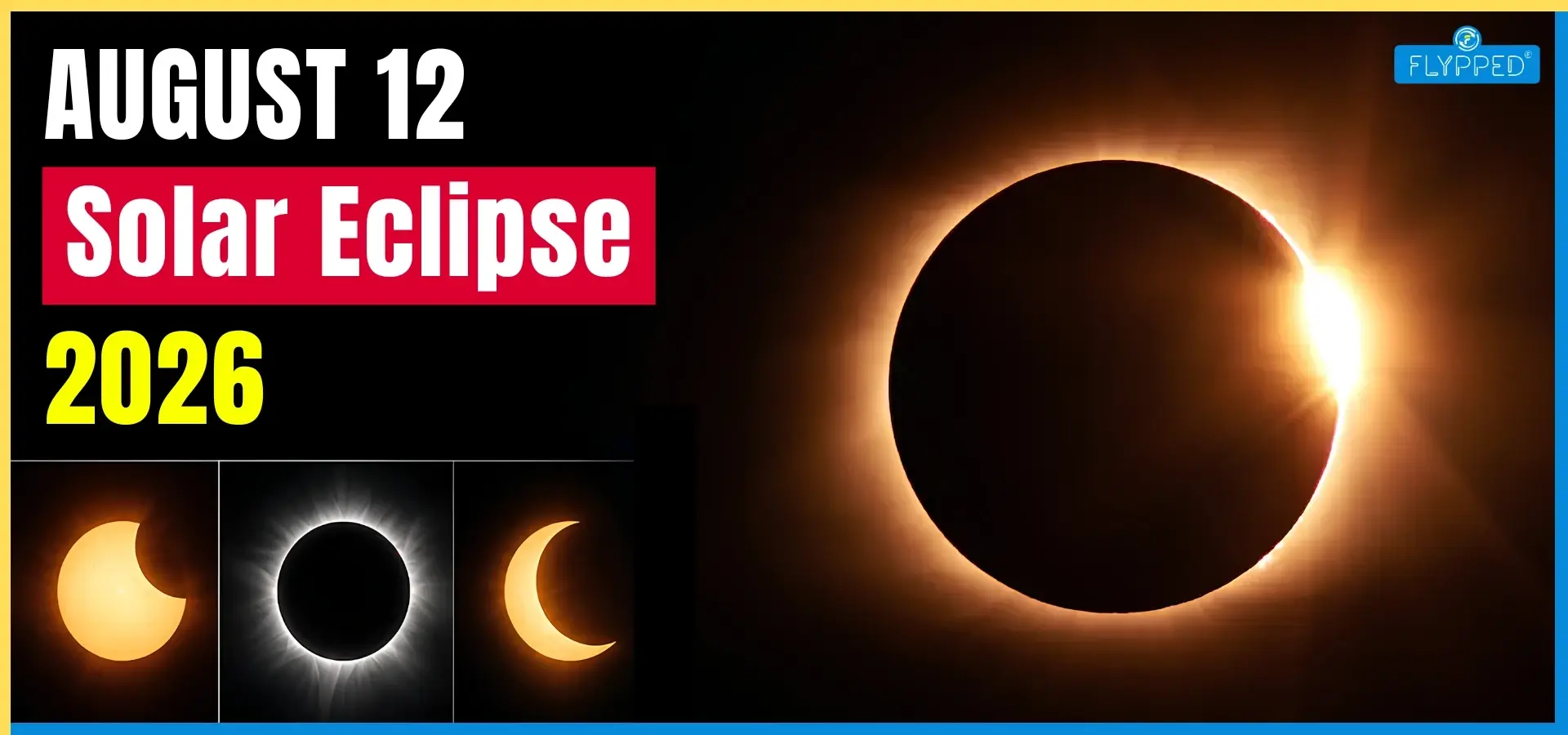
Solar Eclipse 2026: On Wednesday, the Moon will temporarily block the Sun, turning day into darkness during a rare total solar eclipse.
It will be possible for people in Europe, Greenland, Iceland, northwest Africa and certain areas of the United States to see it, either entirely or in part.
NOTE: Stay informed with the latest breaking news, current affairs, top headlines, and latest updates from across the globe.
Solar Eclipse 2026: What is The Reason Behind the Eclipse?
Moon between Sun and Earth: An eclipse occurs when the Moon passes between the Sun and the Earth, blocking sunlight and casting a thin shadow on certain areas of the planet.
When a total solar eclipse occurs, daylight soon gives way to twilight; the temperature may fall, shadows may appear odd, and certain animals may behave as though it were nighttime.
Solar Eclipse 2026 India Timing: Eclipse Won't Be Visible From India
Solar Eclipse 2026: Since the path of the eclipse does not pass through India, people there will not be able to see it, whether it is total or partial, because a solar eclipse can only be seen from places where the Earth is covered by the Moon's shadow.
Solar Eclipse Visibility: Total Solar Eclipse Coming to Europe, Greenland, and Russia
For this eclipse, the shadow of the Moon will cross the Northern Hemisphere, and the total eclipse will go through northern Russia, Greenland, Iceland, Spain and Portugal.
The rest of Europe, North America, and northwest Africa will, however, see only a partial eclipse.
Solar Eclipse Effects: NASA Highlights the "Cosmic Coincidence" Behind Total Solar Eclipses
NASA refers to this as a "cosmic coincidence"; the U.S. space agency states that "even though the Sun is some 400 times bigger than the Moon, it is also some 400 times farther away."
That is the reason why, in certain places, the Moon can completely cover the Sun and enable us to see the Sun’s outer atmosphere, which is known as the corona.
Solar Eclipse Latest News: Brief Total Solar Eclipse to Darken Parts of Europe and Russia
The total eclipse will first be visible in a distant part of northern Russia before moving on to Greenland, then to Iceland, Spain, and the northeastern tip of Portugal; in Spain the path will stretch from the city of Oviedo in the north to the island of Mallorca.
The Brief, Rare Window of a Total Solar Eclipse
Solar Eclipse 2026: In Spain, the total eclipse will last less than two minutes just before sunset, and in some areas of Russia and Greenland it will last a little longer, but it will not exceed two and a half minutes anywhere.
The partial stages of the eclipse—when the Moon begins to cover the Sun and then moves away—will last for about one hour and 45 minutes.
There is usually one or two solar eclipses somewhere on Earth every year, but since the path of totality is so narrow, a particular location might have to wait approximately 400 years before seeing another total eclipse.
Solar Eclipse Latest Update: Rare 2027 Total Solar Eclipse to Span Europe, Africa, and Middle East
Solar Eclipse 2026: A total solar eclipse will take place on August 2, 2027, and will pass across southern Spain, northern Africa, and the Arabian Peninsula.
The total phase of the eclipse will last six minutes and 23 seconds, and the next total solar eclipse will not occur until 2114.
Solar Eclipse Eye Protection: Necessary Precautions To Take
- Don’t look directly at the Sun unless using eye protection specifically designed for solar viewing.
- The only safe time to do so without protection is during the brief period of totality in a total solar eclipse, when the Moon completely covers the Sun.
- You may immediately damage your eyes if you look at the Sun using a camera, binoculars, or a telescope without having a special solar filter in front of the eyepiece.
- Partial and annular solar eclipses are unlike total solar eclipses since the Moon does not completely cover the Sun and eye protection must always be used when viewing them.
- When watching a partial or annular solar eclipse, you should always use safe solar viewing glasses, known as 'eclipse glasses', or a safe handheld solar viewer.
- It is not safe to use ordinary sunglasses, even if they are very dark, when looking at the Sun.
- Solar viewers should be considerably darker than ordinary sunglasses and have to comply with the ISO 12312-2 international standard.
- Before using your eclipse glasses or handheld viewer, make sure that they are in good condition. If you notice any tears, scratches, or other damage, remove them.
- When children are using solar viewers, it is important to keep a close eye on them.
- It is necessary never to look at the Sun through a lens, a telescope, binoculars, or any other optical instrument while wearing eclipse glasses or when using a handheld solar viewer.
- Focused sunlight may burn through the filter and result in serious eye injury.
Read More:
- Trump Tariffs Lawsuit: 25 US States Challenge Trump's India Tariffs in Court
- Nitin Nabin Reaction on Prashant Kishor Victory: Calls It ‘Unexpected’
- Nita Ambani Biography
- Mountaineer Nirmal Purja Loses Life in Avalanche on Broad Peak Summit
- PM Modi Forgives Students: Says 'They Need Guidance, Not Punishment' After Jantar Mantar Protest
- Morocco Ceuta Migrant Crisis: Hundreds of Migrants Swim From Morocco to Spain's Ceuta Enclave
- Raghav Chadha Breaks Silence on NEET Paper Leak: Supports Anti-Paper Leak Bill
- US Military Launches New Strikes on Iran: Tensions Escalate After Jordan Attack
- Exam Bill Passed in Lok Sabha: Anti-Paper Leak Bill Gets Approval