GRAP Restrictions Delhi NCR: What's Banned, What's Allowed and Who Gets Fined at Every Stage
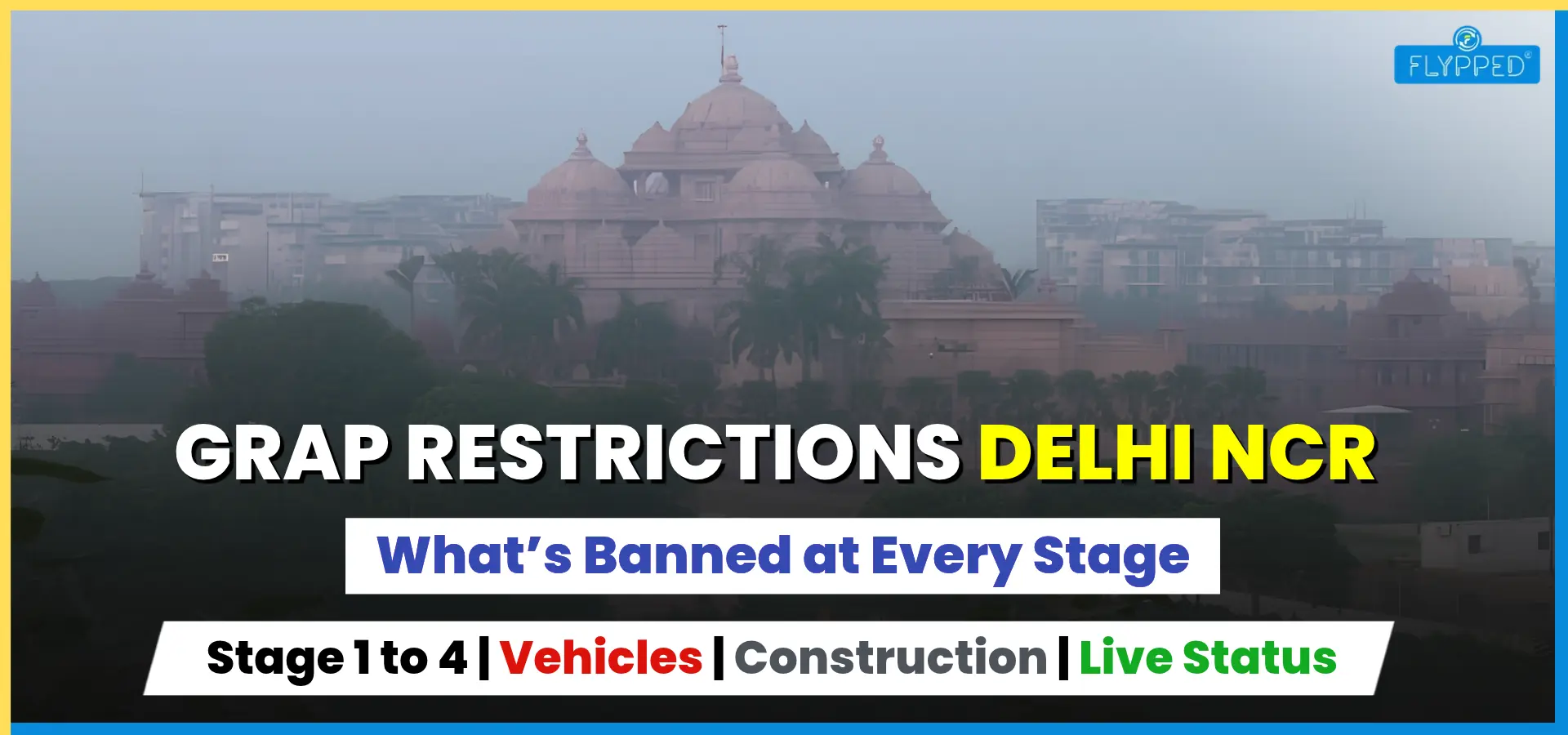
One AQI jump can change what you can drive, build or attend within hours. The GRAP restrictions Delhi NCR are designed to address air quality issues in the region. This article promises to provide stage-by-stage rules, vehicle and construction curbs and a live status box.
GRAP restrictions in Delhi NCR today: Stage 3 in force since [November 6, 2026] | Source: CAQM.
What is GRAP and Who Decides the Stage?
The Graded Response Action Plan (GRAP) is an emergency strategy implemented across the National Capital Region as air quality worsens. It is enforced by the Commission for Air Quality Management (CAQM) through its GRAP Sub-Committee. The stages of GRAP are determined by the average Aqi of delhi and forecasts of air quality and weather. It has been revised several times, notably in November 2025 and September 2026, so older articles may contain outdated rules.
NOTE: Stay informed with the latest breaking news, current affairs, top headlines, and Latest updates from across the globe.
GRAP Stages and AQI Levels at a Glance
Stage | Air Quality | Delhi AQI Range |
Stage I | Poor | 201-300 |
Stage II | Very Poor | 301-400 |
Stage III | Severe | 401-450 |
Stage IV | Severe+ | Above 450 |
Note that measures are cumulative; higher stages add to the lower ones. The CAQM can invoke a stage early based on forecasts.
What Changed in the Latest GRAP Revision?
The November 2025 revision moved several measures down a stage. Curbs previously under Stage IV shifted to Stage III, Stage III measures moved to Stage II and Stage II measures moved to Stage I. The September 2026 revision included actions regarding diesel generators and inter-city buses moving to Stage I, broader car curbs and a more extensive citizen's charter. This earlier intervention is crucial as it allows restrictions to start before the AQI reaches severe levels.
GRAP Restrictions by Stage
GRAP 1 Restrictions in Delhi NCR (Poor, AQI 201-300)
The GRAP 1 restrictions Delhi NCR agencies are enforcing right now include:
Dust control at construction and demolition sites, with regular monitoring for eligible sites for plot area of 500 sq m or more.
Mechanized road sweeping and water sprinkling
Curbs on diesel generator sets and on entry of BS-IV and older inter-city buses, which is moved down from Stage II in the September 2026 revision.
Traffic management, uninterrupted power supply, expanded public transport and public advisories, which is moved down from Stage II in November 2025.
PUC enforcement and action against visibly polluting vehicles
Ban on open burning of waste and biomass
In Delhi, the state government has additionally announced doubled parking charges except at Metro facilities, no fuel for vehicles without a valid PUCC and staggered hours or work from home for MCD and government offices.
Enforcement is carried out by agencies such as the DPCC, MCD, state pollution control boards and traffic police.
GRAP 2 Restrictions in Delhi NCR (Very Poor, AQI 301-400)
The GRAP 2 restrictions Delhi NCR will see if AQI crosses 300 include:
Staggered timings for public offices and municipal bodies in Delhi, Gurugram, Faridabad, Ghaziabad and Gautam Buddh Nagar, which is moved down from Stage III in November 2025; other NCR areas are at their state governments’ discretion.
Central Government may decide on staggering timings for central government offices in Delhi-NCR.
Stage II has eight actions in the revised schedule. Several measures that earlier sat in Stage II, such as diesel generator set curbs, older-bus entry curbs and public transport expansion, now start at Stage I.
Aggregately, this stage includes measures like increased mechanical road sweeping, daily water sprinkling with dust suppressants, higher parking fees to discourage private vehicle usage and restrictions on diesel generator sets and coal or firewood use in hotels and restaurants.
GRAP 3 Restrictions in Delhi NCR (Severe, AQI 401-450)
GRAP 3 Restrictions on Construction Delhi NCR:
Stage III includes a ban on non-essential construction and demolition activities such as earthwork, piling, trenching and road work.
The September 2026 revision added a minor relaxation to the first Stage III action including pothole repair.
Mining and stone crushing are also restricted with exemptions for essential projects such as railways and metro.
GRAP 3 Vehicle Restrictions Delhi NCR covers:
BS-III petrol and BS-IV diesel (and older) four-wheelers are restricted from plying in Delhi, Gurugram, Faridabad, Ghaziabad, Gautam Buddh Nagar and Sonipat (Sonipat was added in September 2026).
BS-IV and older diesel light and medium goods vehicles registered outside Delhi cannot enter Delhi and the exemption for those carrying essential commodities has been removed.
Workplace and school measures: state governments and the Delhi government may allow offices to run at 50% strength and classes up to Class 5 have shifted to hybrid mode when Stage III was invoked, depending on the order in force.
Curbs on older inter-state buses, which earlier applied at this stage, now begin at Stage I.
GRAP 4 Restrictions in Delhi NCR (Severe+, AQI Above 450)
The GRAP 4 restrictions for Delhi NCR pollution emergencies include:
Entry curbs on trucks, with the essential-commodities exemption removed for BS-IV and older heavy goods vehicles
A wider construction ban including public projects
School and workplace measures, such as hybrid classes as notified in the order in force
Are There GRAP 5 Restrictions in Delhi NCR? No. GRAP has four stages, and Stage IV (Severe+) is the highest.
GRAP 1 Restrictions Till Which Date in Delhi NCR?
The GRAP 1 restrictions Delhi NCR is under today have no fixed end date. Stage I was invoked on October 21, 2026 and stays in force until the CAQM’s GRAP Sub-Committee revokes it, depending on AQI trends and weather forecasts. Typically the stage is stepped down, with lower stages staying in force: when CAQM revoked Stage III on January 22, 2026, Stages II and I remained invoked. The same applies if you are wondering about GRAP 4 restrictions till which date in Delhi NCR: there is no fixed end date and Stage IV stays until CAQM revokes it.
GRAP Stage II in Delhi-NCR
The GRAP 2 was implemented in Delhi-NCR with immediate effect on 2 November, 2026. The core measures of this stage covers increased mechanical road sweeping, daily water sprinkling with dust suppressants, higher parking fees to discourage private vehicle usage and restrictions on diesel generator sets and coal or firewood use in hotels and restaurants.
GRAP Stage III in Delhi-NCR
The GRAP 3 was implemented in Delhi-NCR with immediate effect on 6 November, 2026. With this stage restriction covers:
Restrictions on BS-III petrol and BS-IV diesel four-wheelers across Delhi, Gurugram, Faridabad, Ghaziabad, and Gautam Buddha Nagar, alongside restrictions on certain diesel goods vehicles.
Strict bans on dust-generating construction and demolition activities, stone crushers, and mining operations (with exemptions for essential or national importance projects).
Hybrid schooling directives for children up to Class V in select areas, and official advisories for offices regarding work-from-home or reduced staff capacity. Covers all government, government-aided, and unaided recognised private schools under the Directorate of Education (DoE), MCD, NDMC, and the Delhi Cantonment Board, Gurugram, Faridabad, and Sonipat. Noida (Gautam Buddha Nagar) and Ghaziabad.
The Delhi Government has issued an advisory urging private offices across the National Capital Territory of Delhi to operate at 50% on-site strength. The District Administration has enforced a mandatory 50% work-from-home rule for private offices across the district (covering major corporate hubs like Golf Course Road), issuing show-cause notices to non-compliant firms.
GRAP Restrictions in Delhi NCR Today (Live Status)
Current stage, date and time invoked, AQI reading and next review or expected change.
Date | Average Deli AQI | GRAP Stage (in force) | Action by CAQM |
October 21, 2026 | 244-245 | Stage I | Invoked all 25 action points of Stage I across Delhi-NCR with immediate effect, directed strict dust control, mechanized road sweeping, water sprinkling and targeted restrictions. |
November 2, 2026 | +324 | Stage 2 | Increased mechanical road sweeping, daily water sprinkling with dust suppressants, higher parking fees to discourage private vehicle usage and restrictions on diesel generator sets and coal/firewood use in hotels and restaurants. |
November 6, 2026 | 323-326 | Stage III | Invoked Stage III as a precautionary measure ahead of Diwali based on IMD/IITM forecasts. Enforced bans on non-essential construction and demolition, curbs on BS-III petrol and BS-IV diesel four-wheelers, hybrid classes up to Class V and 50% WFH advisories for offices. Maintained Stage III restrictions across Delhi-NCR without rollback, as several local monitoring stations continued recording near-severe levels. |
Who is Affected? Citizens, Drivers, Builders and Schools
Citizens, drivers, builders and schools are all affected by GRAP restrictions.
Car owners should check their vehicle’s BS norm (on the RC and fuel type), since BS-III petrol and BS-IV diesel four-wheelers face curbs at Stage III.
Bus users may see older BS-IV and below inter-city buses restricted from Stage I.
Construction sites must follow dust-control rules from Stage I and non-essential construction stops at Stage III.
Offices may stagger timings from Stage II and may be asked to run at 50% strength at Stage III.
The updated Citizens’ Charter asks residents to avoid open burning, use public transport or carpool and report visible pollution violations.
CAQM directs agencies including state pollution control boards and local bodies, to implement and monitor the actions at each stage. Fine amounts are set by the respective state or CAQM notifications, so check the notification before relying on a figure.
The revised Citizens’ Charter includes 34 actions, up from 22. The main do’s and don’ts include:
Residents: Reduce individual vehicle use, adhere to dust control measures.
RWAs: Implement community-wide compliance and awareness efforts.
Offices: Encourage work-from-home policies and staggered hours.
Final Thoughts
In summary, the GRAP consists of four stages, each imposing key vehicle and construction curbs to mitigate air pollution. Stage I is currently in force, and residents should stay informed about the current status to comply with the GRAP restrictions Delhi NCR follows.
Read More:
- Rahul gandhi petition against gyanesh kumar faces setback over 14 registry objections
- Chennai metro phase ii inauguration: pm modi rides chennai metro with cm vijay
- India rejects elon musk's starlink claims as he questions ambani over delayed approval
- Bypoll election results 2026: bjp leads in west bengal as nandigram counting continues
- India bloc third day protest: 5,000 police deployed as security tightens in central delhi
- Indigo flight struck by lightning at 17,000 feet during descent, passengers safe in lucknow
Frequently Asked Questions
Find answers to common questions about this topic
GRAP restrictions are emergency measures implemented to control air pollution based on air quality levels.
GRAP 1 restrictions involve measures for poor air quality, while GRAP 2 restrictions apply to very poor air quality, including stricter vehicle controls.
GRAP 3 includes bans on non-essential construction and specific vehicle restrictions based on emissions standards.
No, there are only four stages in the GRAP framework.
BS-III petrol and BS-IV diesel vehicles are banned under GRAP 3 restrictions.
Each stage is triggered by specific AQI ranges, from poor to severe+.