Air India Flight 171 Crash: AAIB Report Reveals Fuel Switch Mystery Behind Ahmedabad Tragedy
Air India Flight 171 Crash: The Aircraft Accident Investigation Bureau has published its first official report on the Air India Flight 171 crash.
Ahmedabad Plane Crash: The accident took place just after the plane took off from Ahmedabad airport on June 12, 2025, resulting in 260 deaths.
The report surfaced one month after the crash occurred. Here are the main findings and why they matter:
Air India Flight 171 Crash: How Did the Crash Happen?
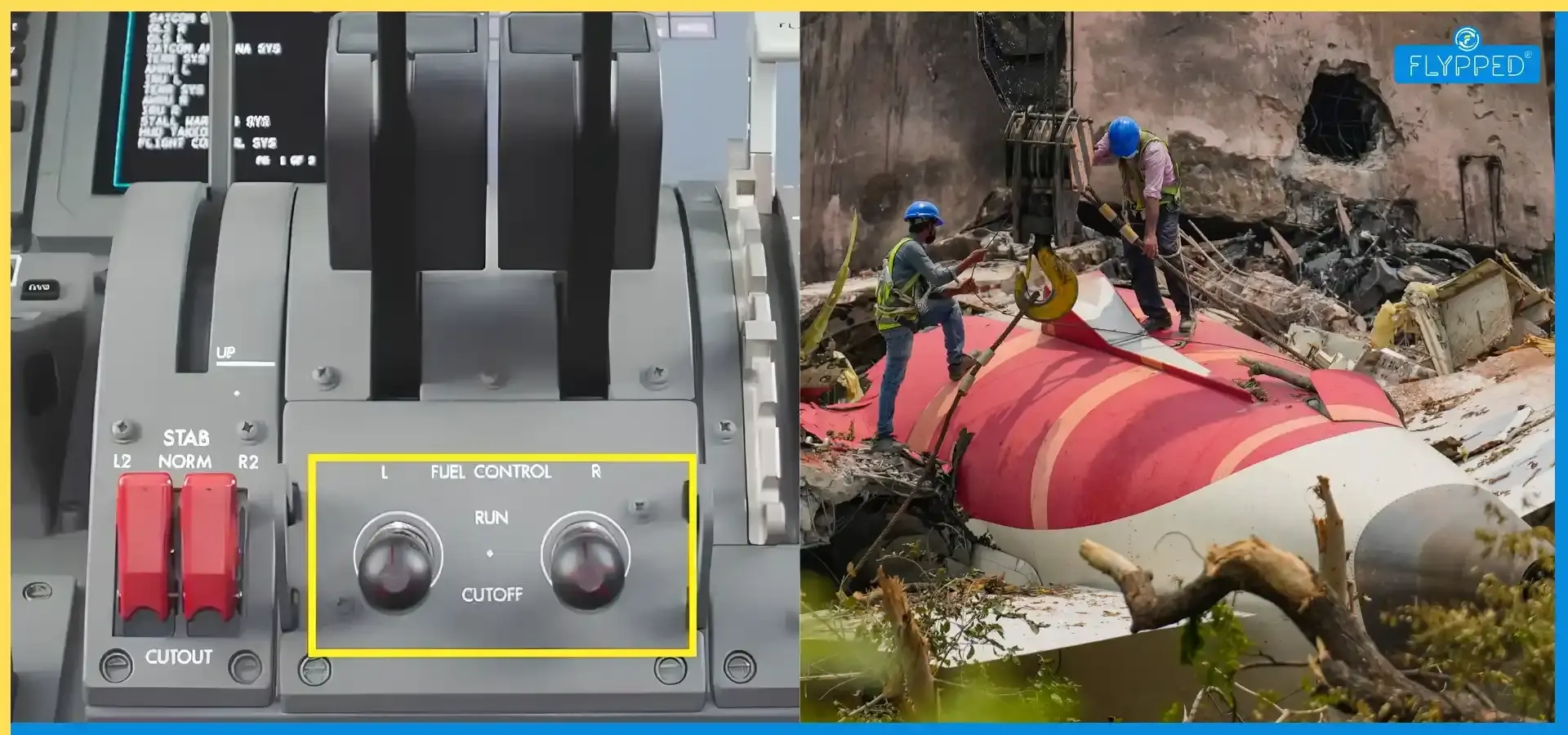
Fuel Switches Moved to Cutoff: Within three seconds of takeoff, the fuel supply to both engines was cut off as the switches moved from RUN to CUTOFF in rapid succession.
This stopped fuel from reaching both engines right away, causing a loss of power and lift.
The report does not explain why the switches moved. It is still not clear if this was caused by human error, a mechanical fault, or an electronic problem.
Learning what happened is important to understand who or what was responsible.
Which Potential Reasons Have Been Excluded?
We have ruled out several possible causes:
- Weather: Conditions were good for flying, with light winds and clear skies.
- Bird strike: There was no evidence of a bird strike in the CCTV footage or during the physical inspection.
- Aircraft configuration: The flaps were set correctly and the landing gear retracted as expected.
- Weight and balance: Both were within normal operating limits.
- Fuel quality: The fuel samples from the airport passed all tests.
- Engine problems: Both engines worked normally until the fuel cutoff.
Air India Crash Cause: Was Pilot Responsible?
Air India Flight 171 Crash: There is still no clear answer. The voice recording captures one pilot asking the other why he stopped the fuel, but the second pilot denies doing so.
This does not rule out human error, but it suggests the fuel cut-off could have been accidental.
Cockpit Voice Recording: What Went on Behind the Cockpit Doors?
First Officer Clive Kunder was flying the plane, while Captain Sumeet Sabharwal was supervising. It is common for the less experienced pilot to fly while the senior captain oversees.
The report only summarizes the discussion about the fuel cutoff switch: “One pilot asks the other, 'Why did you cut off?' The other pilot said he did not.” The full conversation is not included.
Note: Stay informed with the latest breaking news, current affairs, top headlines, and latest updates from across the globe.
Did the Crew Have a Chance to Save the Plane?
Air India Flight 171 Crash: The pilots made a brave effort to save the plane. Within 10 to 14 seconds after the fuel stopped, they switched both controls back to “RUN”.
Both engines began trying to restart. Engine 1 showed signs of working again, and engine 2 also tried to restart.
However, there was not enough time or altitude. The engines stopped at only 625 feet, but restart procedures usually need much more than the 29 seconds available before impact.
Jet engines typically require several minutes and higher altitudes to restart successfully. Were there any problems with the plane?
Fuel Control Switch Failure: FAA warned of this Boeing fuel switch risk back in 2018
The plane VT-ANB had a good maintenance record, and there had been no problems with the fuel control switch since 2023. All inspections were current, and the plane had valid safety certificates.
However, a 2018 US Federal Aviation Administration bulletin (SAIB No. NM-18-33) discussed possible problems with the locking mechanism of fuel control switches on Boeing aircraft, including the 787.
The bulletin was issued after reports that 737 fuel switches had been installed without the locking features engaged.
What Issues Did the Advisory on Switches Highlight?
Air India Flight 171 Crash: The 2018 FAA bulletin focused on fuel control switch locking mechanisms that prevent accidental movement.
If the locks are not engaged, the switches can move more easily because of vibration, contact, or other reasons.
The FAA did not require any fixes, but only recommended inspections to make sure the locks were working properly.
Ahmedabad Latest News: Air Crash Findings Remain Inconclusive, Final Safety Report Yet to Come
Air India Latest Update: The results outlined here remain tentative and may be updated as more evidence emerges.
A final report determining probable cause and safety recommendations is yet to be released.
The media reported earlier in the week that AAIB was awaiting an engine analysis, which has delayed the final report.
Vishwas Kumar Ramesh: The Miracle Man Who Survived Air India AI-171 Crash

Many people know Vishwas Kumar Ramesh as the miracle man from the Air India AI-171 crash. He was the only survivor from a Boeing 787 accident that killed 260 people.
A year later, Kumar says surviving was just the start of his struggle. Out of the spotlight, he has dealt with sleepless nights, anxiety, and memories that will not go away.
Kumar explained that while people saw him survive, they did not see his private struggles. He still has trouble sleeping, feels anxious, and lives with painful memories.
The crash near Ahmedabad on June 12, 2025, lasted only seconds, but Kumar says its impact has stayed with him every day.
The plane was heading to London when it crashed into the BJ Medical College campus just after take-off, killing 241 of the 242 people on board and 19 people on the ground.
Kumar survived with injuries, but his brother Ajay, who was sitting in another part of the plane, did not.
He is grateful to have survived, but finds it very hard to put his experience into words.
His words give a glimpse into the emotional burden carried by the 40-year-old British national, who was suddenly in the spotlight as the only passenger to survive one of India's worst aviation disasters.
Right after the crash, images of a bloodied and limping Kumar walking away from the site appeared on television and social media.
From his hospital bed just hours later, he described waking up among wreckage and bodies before finding his way to safety.
When speaking to the media, he shared how seeing the bodies around him terrified him and made him run.
The crash claimed the life of his brother, Ajay Kumar Ramesh, who was travelling with him to London after a family visit in India.
Over the past year, Kumar has often spoken about this loss, calling it the deepest wound left by the tragedy.
Injuries healed, But Emotional Scars Still Sustain
Friends, advisers and family members have previously described how Kumar struggled with recurring memories of the crash, difficulty sleeping and the challenge of adjusting to life after surviving an event that killed almost everyone around him.
He has spoken of feeling isolated, of withdrawing from public life, and of finding it difficult to move beyond the events of that afternoon.
The disaster also brought financial strain. According to earlier accounts, Kumar and his brother had invested much of their savings in a fishing business in India.
After the crash and Ajay's death, the family's plans were thrown into uncertainty, adding another layer of stress to an already devastating year.
His statement comes as India marks one year since the crash of Air India flight AI-171 and investigators prepare to release a status update on the probe into the accident.
Read More:
- Rahul Gandhi CBSE Controversy: Mobile Scanning Claims Rock OSM Tender Row
- Iran Peace Agreement: Tehran Rejects Trump’s Claims on Hormuz and Nuclear Deal
- Vinesh Phogat Asian Games Trials: Supreme Court Allows Wrestler, Questions WFI Policy
- Karnataka CM Resignation News: Siddaramaiah Quits CM Post After Congress Order
- CBI arrests Giribala Singh: Twisha Sharma’s Mother-in-Law Arrested After Bail Cancellation
- Legendary Urdu Poet Bashir Badr Death Leaves Behind Timeless Legacy
- US Iran War Latest News: Kuwait on Alert After Fresh US Strikes on Iran
- RCB Beat Gujarat Titans as Kohli AB Reunion Truly Win Hearts
- Pinarayi Vijayan Daughter Case: T Veena Under Scanner as ED Searches CM’s Residence
- Marco Rubio Iran Deal: Hormuz To Be Reopened After US Strikes on Iranian Boats