
China's World's Largest Fusion Magnet: China Unveils Magnet for Artificial Sun
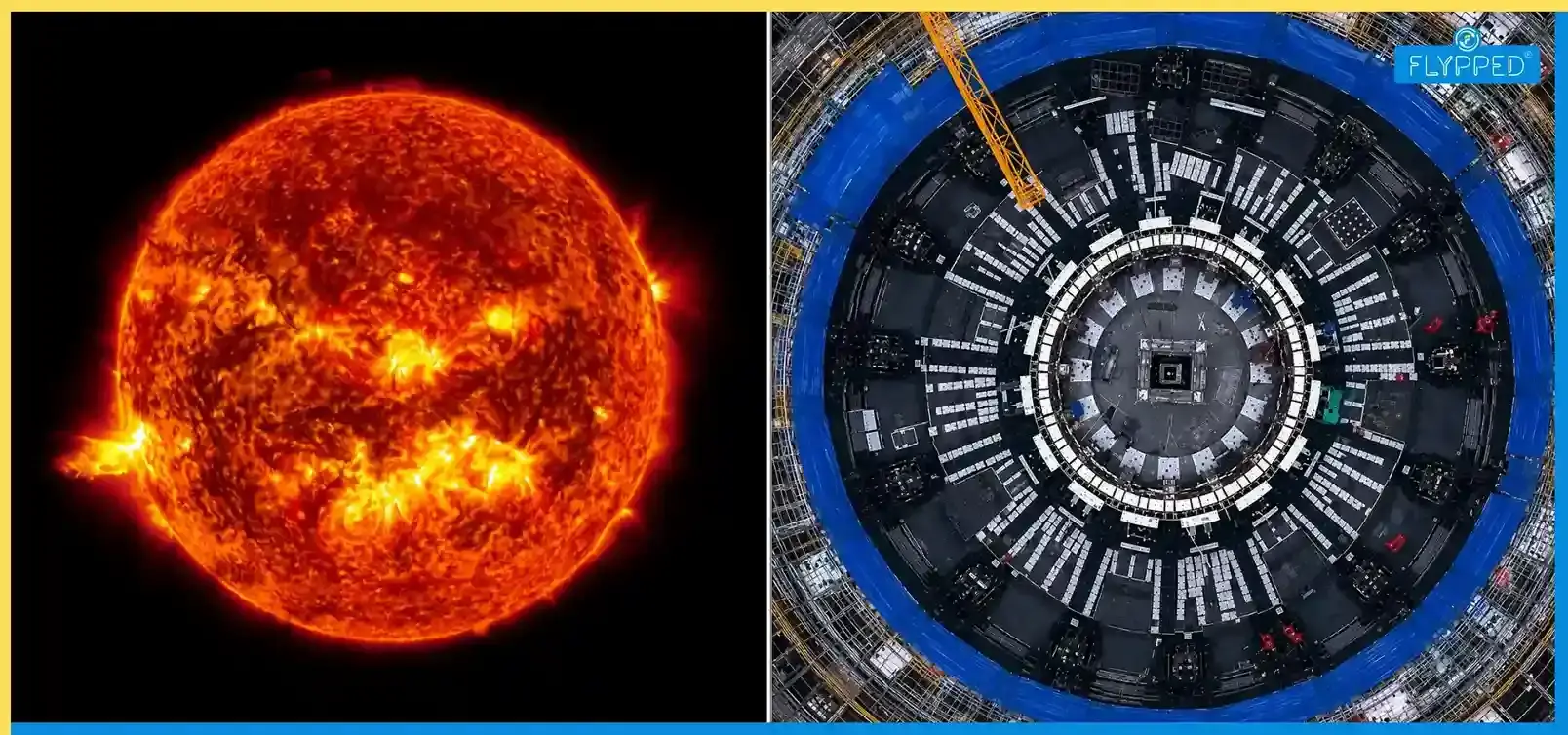
China’s World's Largest Fusion Magnet: China has made a major advancement in its efforts to create an artificial Sun by completing and testing the world's largest superconducting fusion magnet. This magnet is a vital component in producing clean and almost unlimited energy through nuclear fusion.
This success brings China nearer to achieving its aim of generating electricity from fusion power by about 2030 and also puts China among the countries at the forefront of those attempting to use what scientists regard as the best source of carbon-free energy.
NOTE: Stay informed with the latest breaking news, current affairs, top headlines, and latest updates from across the globe.
China’s World's Largest Fusion Magnet: Could This End the Energy Crisis?
The Chinese Academy of Sciences' Institute of Plasma Physics constructed the new toroidal field superconducting magnet, which is a large D-shaped device measuring 21 metres in length, 12 metres in width, and weighing 582 tons.
At temperatures above 100 million degrees Celsius, the magnet fuses hydrogen atoms and, in the process, releases a great deal of energy without producing carbon dioxide.
Scientists believe this technology might provide a nearly unlimited, clean, and safe method of generating electricity in the future.
China's Massive Fusion Magnet Packs 3 Times More Energy Than ITER's
China Artificial Sun Project Latest News: Researchers have stated that this is the largest superconducting magnet ever constructed for a fusion reactor; it has 1.3 times the volume and three times the stored energy of the magnets used in the International Thermonuclear Experimental Reactor (ITER), which is the world's largest fusion project.
The powerful magnetic field it produces holds the plasma — a superheated gas at around 100 million degrees Celsius — inside the reactor so that it doesn't come into contact with the walls.
They also carried out tests on a high-temperature superconducting central solenoid coil, which is often referred to as the heart of a fusion reactor.
Similar to a spark plug in a car engine, this component is used to start and maintain the plasma for the fusion reaction.
China Fusion Energy Milestone: Develops 100% Indigenous Fusion Reactor Technologies, Files 47 Patents
China’s World's Largest Fusion Magnet: China claims that it has developed both of these technologies using only locally available materials and local manufacturing, thus no longer depending on foreign suppliers for the key parts of fusion reactors.
The research team notes that their six-year programme led to 47 patents and 25 industry standards.
China's Artificial Sun Breakthrough Boosts Hopes for Unlimited Clean Energy
China's Clean Energy Future: The construction of the magnet involved a great deal of precise engineering since it has to function reliably for 60 years at temperatures close to minus 269 degrees Celsius, carry high electrical currents, and endure strong radiation and mechanical stresses.
The engineers managed to reduce the electrical resistance in the key joints to nearly zero.
As a result, currents exceeding 100,000 amperes can flow with very little energy loss, a feature that is essential for commercial fusion reactors.
This achievement contributes to China's advancements in fusion research.
Tokamak Reactor: Earlier this year, its Experimental Advanced Superconducting Tokamak (EAST), known as China's artificial sun, set a world record by maintaining plasma at 100 million degrees Celsius for 1,066 seconds.
This demonstrated that it is possible to keep fusion conditions going for a long time.
Fusion Power Technology: China Moves Closer to Artificial Sun Goal with 2030 Fusion Power Timeline
High-Temperature Plasma: China has a three-step plan for commercial fusion: the Burning Plasma Experimental Superconducting Tokamak should be completed by the end of 2027, and the first fusion power generation is expected around 2030.
China’s World's Largest Fusion Magnet: China's final aim is to build the China Fusion Engineering Demonstration Reactor, which could become the world's first fusion demonstration power station.
Artificial Sun Moves Forward, Yet Commercial Fusion Remains a Challenge
China's artificial Sun project Latest Update: Despite this progress, researchers caution that there are still major challenges to come.
They have to complete the construction of the reactor, carry out long-term tests, and have to demonstrate that the technology can reliably produce more energy.
Yet the scientists state that each new breakthrough brings us nearer to achieving unlimited, zero-carbon energy, something which could alter the way the world generates electricity.
Read More:
- Skyroot Vikram-1 Launch: PM Modi Wishes Success Ahead of Launch
- Sonam Wangchuk Hunger Strike Day 21: Activist Shifted to Hospital by Police
- Sonam Wangchuk Hunger Strike Day 20 Doctors Warn of Organ Failure Risk During Protest Fresh Health Concerns
- Sonam Wangchuk Protest: Wangchuk Refuses to End Hunger Strike Despite Health Concerns
- Supriya Sule Delimitation Bill: NCP (SP) Demands Written Assurance on 50% Lok Sabha Seat Increase
- Graham Staines Murder Case: Convict Dara Singh May Walk Free Under Independence Day Remission
- US Russia Sanctions Bill: US Lowers Proposed Tariff to 100%, India and China Still in Focus
- Yemen Sanaa Airport Attack: Saudi Arabia Faces Houthi Strike After Airport Attack
- US Iran War Live Updates: Trump Announces Iran Blockade as Middle East Conflict Escalates