Narendra Modi Biography: Journey from Vadnagar to PM, Political Career, Elections & National Impact
Introduction
Narendra Modi's biography is one of India's most searched topics, as many seek to understand his impact—from his beginnings in Gujarat to becoming Prime Minister in 2014.
His journey exemplifies determination, hard work, and perseverance as he shapes Indian politics over several decades.
Through major reforms, development projects, and strengthening global ties, Modi has driven significant national change.
This blog highlights the Prime Minister’s education, family, political career, election history, net worth, and recent updates on his leadership.
Narendra Modi Early Life
Narendra Modi was born on 17th September 1950 in Vadnagar, Gujarat, to a modest family.
As a child, he often helped his father sell tea at a railway station. These early experiences taught him discipline, responsibility, and the value of hard work.
As he grew up, Modi became interested in public service and social work, eventually joining the RSS (Rashtriya Swayamsevak Sangh).
This experience helped him build organisational and leadership skills, which later opened doors for him in politics.
NOTE: Stay informed with the latest breaking news, current affairs, top headlines, and latest updates from across the globe.
Narendra Modi Age: Know His Secret of Fitness
A key fact you will find in any Narendra Modi biography is his age. Based on his date of birth, which is 17th September 1950, he is currently 75 years old.
Well, where most celebrities show signs of ageing and look frail, Narendra Modi defies age with his radiant appearance, which stems from his strict discipline and an active schedule that includes governance, election campaigns, public events, and global meetings.
His energy and commitment to public service are often highlighted by supporters and political observers alike.
PM Modi usually eats a simple, vegetarian diet, choosing foods that are light, healthy, and easy to digest.
For breakfast, he often has boiled or roasted foods, upma, khichdi, kadhi, or khakra, all made with little extra fat.
His morning routine always begins with ginger tea. He also avoids eating after 6 PM, which helps with digestion and sleep.
In a podcast interview, the Prime Minister shared that fasting is the main reason he feels healthy in his 70s, and he has been doing it for over 50 years.
He thinks fasting sharpens the senses, builds discipline, and helps with mental clarity. For him, fasting is more than just skipping meals.
It is a way to reset, gain self-control, and become more aware. He sleeps about 3.5 hours each night. Eating dinner early also helps him keep his body clock and digestion on track.
Narendra Modi Education
Modi's biography also raises curiosity about the education of our honourable Indian Prime Minister.
He finished school in Gujarat and then studied Political Science at Gujarat University, earning both a bachelor’s and a master’s degree.
His education helped him understand administration, governance, and public policy.
Later, he focused on digital learning, skill development, and making education better for young people in India.
Narendra Modi Family
Apart from his education, Narendra Modi's family background is also important. He was born to Damodar Das Modi and Hiraba Modi and is the third of six children.
Modi grew up in a modest household with a simple lifestyle and limited money.
Modi often talks about the values of honesty, hard work, and dedication that he learned from his parents.
His mother, Hiraba Modi, remains an important figure in his life, and he often mentions her in his speeches.
Narendra Modi Political Career
Modi’s rise in Indian politics began with his early association with RSS and later with the Bharatiya Janata Party (BJP). He is widely regarded for his strong organisational skills and strategic planning.
In 2001, he became the Chief Minister of Gujarat and served until 2014.
During his tenure, he emphasised infrastructural development, governance reforms, and industrial growth. His leadership in Gujarat gave him national attention.
In 2014, under his leadership, the BJP won the Lok Sabha elections, and Modi took the oath of office as Prime Minister of India.
In 2019, he was re-elected and again formed the government after the 2024 general elections, starting his third consecutive term as Prime Minister.
Narendra Modi Election History: A Quick Overview
Any detailed Narendra Modi biography cannot be completed without the mention of his election history. His electoral journey features multiple major feats, starting from
Gujarat Elections
- Became Chief Minister of Gujarat in 2001.
- Led BJP to victories in Gujarat Assembly elections in 2002, 2007, and 2012.
Lok Sabha Elections
- 2014: BJP won a majority and Modi became Prime Minister.
- 2019: BJP secured an even larger mandate.
- 2024: Modi returned as Prime Minister for a third consecutive term.
His election history demonstrates his exceptional ability to attract votes across various regions of India.
Narendra Modi Net Worth in Rupees
Moving on from his family background, age, and political career, another common search topic is PM Modi’s net worth in rupees.
Based on publicly available election affidavits and official disclosures, his assets are modest compared to those of most political leaders.
His net worth varies annually due to regular updates. Throughout his political career, Modi has highlighted clean governance, transparency, and financial accountability.
Some Major Achievements as Prime Minister
The success of Narendra Modi’ political career can be measured on these notable initiatives.
Digital India
- Launched on July 1, 2015, by Prime Minister Narendra Modi, Digital India aims to transform the nation into a digitally empowered, knowledge-based economy.
- It has significantly improved direct online access, broadband networks, and mobile connectivity.
- Today, India proudly ranks third globally in digitalisation, driven by robust infrastructure.
- Looking ahead to the 'Viksit Bharat' (Developed India) 2047 vision, the initiative strongly focuses on empowering citizens through education, skill development, and social welfare.
- By prioritizing advanced technologies like artificial intelligence, quantum computing, and space exploration, Digital India seeks to foster inclusive growth, drive innovation, and establish India as a global technological leader.
Make in India
- The Prime Minister launched Make in India during a crisis, and it quickly united stakeholders and partners from across the country.
- The initiative encouraged citizens and business leaders to participate and drew attention from potential partners and investors worldwide.
- Make in India is not just a slogan; it marks a major change in existing processes and policies.
- Most importantly, it reflects a real shift in how the government works, moving from issuing orders to collaborating with businesses, in line with the Prime Minister's idea of ‘Minimum Government, Maximum Governance’.
Swachh Bharat Mission
- Launched by Prime Minister Narendra Modi, the Swachh Bharat Abhiyan is a massive national campaign aiming to fulfill Mahatma Gandhi’s dream of a clean India.
- Modi initiated the movement by taking a cleanliness pledge, leading a walkathon, and cleaning streets, popularizing the mantra, ‘Na gandagi karenge, Na karne denge.’
- He also emphasized building toilets to resolve critical sanitation issues. The campaign quickly transformed into a nationwide movement.
- Citizens, government officials, celebrities, and organizations united for cleanliness drives and awareness programs.
- Through social media campaigns like '#MyCleanIndia,' the Prime Minister continues to praise and encourage widespread participation in this vital mission.
UPI and Digital Payment Expansion
- Launched by NPCI in 2016, the Unified Payments Interface has transformed digital payments in India.
- By linking multiple bank accounts to a single mobile app, UPI enables fast and secure transactions.
- In October 2024, the platform reached a massive milestone, processing a record 16.58 billion transactions worth ₹23.49 Lakh Crores, marking a 45% increase from the previous year.
- Currently supported by 632 banks, UPI’s convenient and contactless nature accelerated its rapid adoption during the pandemic.
- It continues to empower individuals, street vendors, and small businesses, playing a vital role in driving India’s transition toward a fully inclusive, modern, cashless economy.
Jal Jeevan Mission
- The Jal Jeevan Mission (JJM) began on August 15, 2019, when Prime Minister Narendra Modi announced a plan to provide tap water to every rural home by 2024.
- At that time, just 3.23 crore (17%) of rural households had tap water.
- The mission set out to reach 16 crore more homes, upgrade water systems, and help over 19 crore rural families.
- Its main goals are to close the gap between rural and urban areas and improve public health.
- By August 12, 2024, the Jal Jeevan Mission had brought tap water to 11.82 crore more rural homes, raising the total to over 15.07 crore households, or 77.98% of all rural homes in India.
- This progress has made a big difference for rural families by giving them reliable access to clean water at home.
PM Gati Shakti Yojna
- The Gati Shakti initiative serves as India's comprehensive master plan for integrated multi-modal transportation and connectivity.
- Launched by Prime Minister Narendra Modi on October 13, 2021, the plan aims to build quality infrastructure across the country in a coordinated way.
- It brings together 16 ministries to work on projects that improve connections between different types of transportation.
- By making these links stronger, the plan wants to make logistics and services more efficient. It also supports last-mile connectivity and works to reduce travel times.
Startup India
- Startup India is a government campaign that Prime Minister Narendra Modi launched on 15 August 2015 at the Red Fort in New Delhi.
- The main aim is to set up more than 75 startup support hubs across India.
- If you are preparing for the IAS exam, you will find ‘Startup India’ in the Government Schemes section of the Indian Polity and Governance syllabus (GS-II).
- The scheme started officially on 16 January 2016 to support start-ups in India, mainly by providing bank financing.
- Former finance minister Arun Jaitley inaugurated the scheme.
Skill India Mission
- Prime Minister Narendra Modi started the Skill India Mission in 2015 to help India become more self-reliant.
- The mission focuses on offering skill development programs that match what industries need and help the country grow.
- Skill India provides courses with standard curricula, so trainees can earn certificates from recognised centres.
- The mission also introduces skill-based learning in schools and creates both short-term and long-term training and job opportunities.
- Employment has improved since the mission began.
- According to the Periodic Labour Force Survey (PLFS) by MoSPI, India’s unemployment rate dropped from 5.6% in June 2025 to 5.2% in July 2025, which is a good sign.
- The India Skills Report 2025 says that employability among Indian graduates in Skill India has increased to 54.81%.
- This means the mission’s training has helped people get jobs in areas like manufacturing, IT, services, and construction.
Modi International News
Narendra Modi has strengthened India's relationships with major countries including the United States, Japan, France, Australia, and several Middle Eastern nations.
His participation in G20, BRICS, Quad, and other international forums has increased India's global visibility.
World leaders often acknowledge India's growing role in global economic and strategic matters.
Recent international discussions have highlighted Modi's long tenure and India's expanding influence on the world stage.
Narendra Modi Latest Update: Modi Breaks Nehru Record, Becomes India's Longest-Serving Prime Minister
For readers looking for Narendra Modi Biography updates, recent developments show that he continues to lead India through his third term as Prime Minister.
In June 2026, Narendra Modi achieved the milestone of becoming India's longest-serving elected Prime Minister, surpassing the previous record held by Jawaharlal Nehru.
This marked an important moment in India's democratic history.
Recent reports also show his continued focus on infrastructure projects, youth employment, economic growth, and international diplomacy.
Impactful Leadership
Narendra Modi is known for strong communication skills, direct interaction with citizens, and a focus on technology-driven governance.
Programs such as "Mann Ki Baat" allow him to communicate directly with people across the country.
His supporters view him as a decisive leader who prioritizes development and national interests.
Operation Sindoor Under Modi Initiative
On April 30, 2026, Defence Minister Rajnath Singh spoke at the National Security Summit in New Delhi.
He said that Operation Sindoor showed India responds to terror attacks with action instead of just words.
Singh emphasised that the Modi government has taken decisive steps and will not tolerate terrorism.
He highlighted the surgical strikes, air strikes, and Operation Sindoor as examples of this strong approach.
Facing Criticism
Like every major political leader, Narendra Modi's decisions have often been discussed and debated by supporters and critics alike.
During his tenure as Prime Minister, several major policy decisions attracted national attention.
These included demonetization in 2016, the implementation of the Goods and Services Tax (GST), agricultural reforms, and various economic policies.
Supporters argued that these initiatives were designed to improve transparency, strengthen the economy, and encourage long-term growth.
Critics, however, raised concerns about their short-term impact on businesses and ordinary citizens.
Despite political debates and criticism, Modi has continued to maintain a strong public presence and remains one of the most recognized political leaders in India.
His ability to communicate directly with citizens through rallies, social media, and public programs has helped him maintain a strong connection with many voters.
Digital Transformation Under Narendra Modi
One of the most significant developments during Modi's leadership has been India's rapid digital transformation. Digital governance has become a key feature of his administration.
Government services have increasingly moved online, making them more accessible to citizens across the country.
Digital payment systems have expanded rapidly, allowing millions of people to make secure transactions through smartphones and online platforms.
The Unified Payments Interface (UPI) has become one of the world's most successful digital payment systems.
It has changed how people transfer money, pay bills, and conduct business. This digital revolution has helped improve financial inclusion, especially in rural and semi-urban areas.
Many experts consider digital governance one of the defining achievements associated with Narendra Modi's leadership.
Social Welfare Programs
A comprehensive Narendra Modi biography also includes various social welfare initiatives introduced during his tenure.
Several programs have been launched with the aim of improving the lives of ordinary citizens.
These include housing schemes for low-income families, financial inclusion programs, health insurance initiatives, sanitation projects, and rural development efforts.
The Swachh Bharat Mission focused on improving cleanliness and sanitation across the country.
The program encouraged the construction of toilets and promoted awareness about hygiene.
The Pradhan Mantri Jan Dhan Yojana aimed to provide banking services to millions of people who previously did not have bank accounts.
Similarly, healthcare initiatives sought to make medical treatment more accessible and affordable for many families.
These programs have played a significant role in shaping the government's development agenda.
Narendra Modi and Foreign Relations
When discussing Modi international news, it is important to understand Narendra Modi's approach to foreign policy.
Since becoming Prime Minister, he has actively engaged with world leaders and strengthened India's diplomatic relationships.
India has expanded cooperation with countries across Asia, Europe, Africa, the Middle East, and North America.
Modi has participated in numerous international summits and bilateral meetings aimed at promoting trade, security, technology partnerships, and cultural exchanges.
His visits to different countries have often focused on attracting investments, strengthening strategic partnerships, and increasing India's role in global decision-making.
Many international observers view India as an increasingly influential global power, and Modi's diplomatic efforts have contributed to this perception.
Legacy and Historical Significance
As historians and political analysts study modern India, Narendra Modi biography will likely remain an important subject for future generations and will continue to inspire them that with dedication and hardwork anything can be achieved.
His political journey from a small-town background to becoming Prime Minister represents one of the most remarkable stories in Indian politics.
Whether viewed through the lens of governance, economic reforms, digital transformation, infrastructure development, or foreign policy, his tenure has had a significant impact on the country.
Modi's leadership has coincided with major changes in technology, global politics, and economic development.
His policies and decisions will continue to be evaluated and discussed for many years.
PM Modi At London's Madame Tussauds Wax Museum
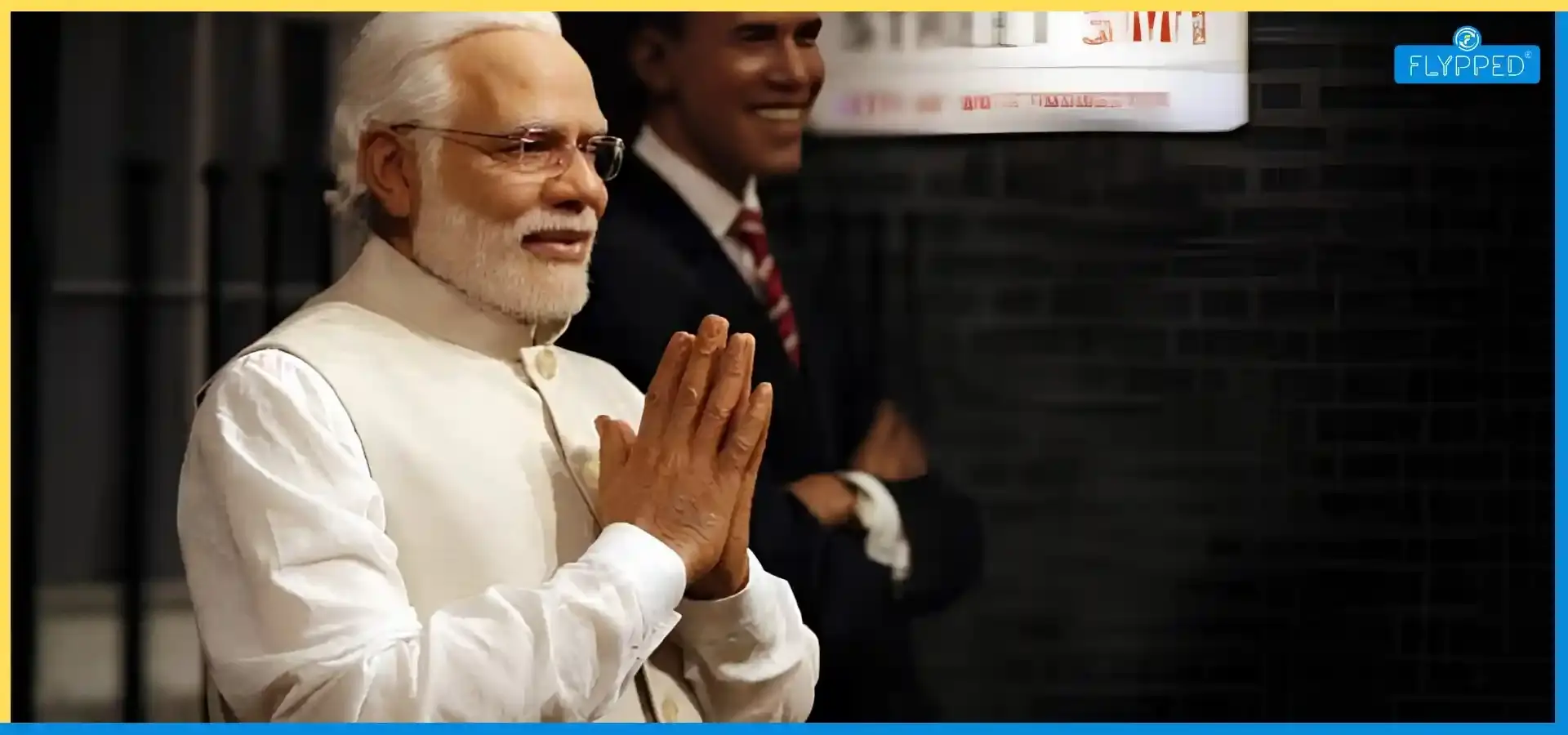
Prime Minister Narendra Modi’s statue is displayed in the World Leaders section at Madame Tussauds, alongside figures like Barack Obama, David Cameron, Angela Merkel, Francoise Hollande, Mahatma Gandhi, and Winston Churchill.
Modi helped create his wax figure and said he was happy with the result, complimenting the team’s work.
The statue shows him in his usual cream kurta and jacket, greeting visitors with a traditional namaste.
Final Thoughts
The story of Narendra Modi biography reflects determination, ambition, leadership, and public service.
From his humble beginnings in Gujarat to becoming the Prime Minister of India, his journey has inspired many people across the country.
His early life experiences, educational background, family values, political achievements, election victories, and international presence have made him a significant figure in contemporary Indian history.
Whether one studies his governance model, development initiatives, or diplomatic efforts, Narendra Modi's influence on modern India is undeniable.
As India continues to evolve in the coming years, Narendra Modi's role in shaping the country's political and economic landscape will remain an important chapter in Indian history.
Read More:
- Rahul Gandhi CBSE Controversy: Mobile Scanning Claims Rock OSM Tender Row
- Iran Peace Agreement: Tehran Rejects Trump’s Claims on Hormuz and Nuclear Deal
- Vinesh Phogat Asian Games Trials: Supreme Court Allows Wrestler, Questions WFI Policy
- Karnataka CM Resignation News: Siddaramaiah Quits CM Post After Congress Order
- CBI arrests Giribala Singh: Twisha Sharma’s Mother-in-Law Arrested After Bail Cancellation
- Legendary Urdu Poet Bashir Badr Death Leaves Behind Timeless Legacy
- US Iran War Latest News: Kuwait on Alert After Fresh US Strikes on Iran
- RCB Beat Gujarat Titans as Kohli AB Reunion Truly Win Hearts
- Pinarayi Vijayan Daughter Case: T Veena Under Scanner as ED Searches CM’s Residence
- Marco Rubio Iran Deal: Hormuz To Be Reopened After US Strikes on Iranian Boats